Whitewater River Rafting and Adventure Research blog at Triad River Tours. An inquiry into the state and nature of the river running industry and a guide to vacations and mountain adventures with professional guides.

4 Rafts That Are Great For Whitewater Rafting
Throughout 2018, there have been an estimated 700,000 whitewater paddlers in the United States. Some of these rafters have been paddling for decades and some have just begun this tremendously fun and exhilarating hobby. Rafting difficulty ranges from class 1 whitewater rafting to class 5 whitewater rafting.

Throughout 2018, there have been an estimated 700,000 whitewater paddlers in the United States. Some of these rafters have been paddling for decades and some have just begun this tremendously fun and exhilarating hobby. Rafting difficulty ranges from class 1 whitewater rafting to class 5 whitewater rafting.
Safety, skills, and owning and wearing the correct gear is essential, but it's just as important to be fully aware of all the various types of whitewater rafting rafts:
Whether you're just starting out or are planning on taking multiple class 5 whitewater rafting trips this year, here are some of the various types of whitewater rafts that you should know:
Kayaks -- Kayaks are the most well-known rafting craft when it comes to whitewater paddling. There are two types of kayaks: sea kayaks and whitewater kayaks. Sea kayaks are typically much longer and far less maneuverable than those used for whitewater rafts.
Catarafts -- These rafts are built with a metal frame called shredders. They are made from two inflatable pontoons on both sides of the raft and they are bridged in the middle by a solid frame. Only one person rows this raft at once.
Canoes -- The traditional rafting vehicle is the canoe, which has been around for centuries, first created from tree trunks. Nowadays, these rafts are made from Kevlar, plastic, and even fiberglass. Additionally, spray covers are equipped on the canoe's frame in order to keep water out from the hull. If a canoe rolls over in the water, it can be tipped and flipped over, though not as easy as it is to flip a kayak back over.
River Bugs -- River Bugs are great for whitewater rafting but are for much more experienced paddlers since they are extremely small and involve hand and feet paddling. You won't have to steer this raft all that much, so just sit back and enjoy the ride!
Whether you’re an experienced class 5 whitewater rafter or you’re thinking about booking a trip down the Snake or Wenatchee river, give Triad River Tours a call right away.
Read more:

It's Time to Enjoy This Summer: 3 Great Outdoor Activities to Try
The outdoor recreation industry generates approximately $887 billion in consumer sales each year, but many American families stay put throughout the summer and never do any sort of fun-filled outdoor activities. From river rafting trips to hiking adventures, it’s time to experience the outdoors and have some fun.

The outdoor recreation industry generates approximately $887 billion in consumer sales each year. Even though that's a ridiculous amount of money, many American families stay put throughout the summer and never do any sort of fun-filled outdoor activities.
There is still plenty of time to get outside with the entire family and have fun doing something you have never done before. From river rafting trips to hiking adventures, it’s time to experience the outdoors and have some fun.
Here are some fantastic outdoor activities you should consider partaking in while it’s still nice out:
Hells Canyon rafting trip -- River rafting trips are extremely fun and exhilarating. You and your family will have a blast and might even schedule a yearly Hells Canyon rafting trip. Keep in mind, you shouldn't go on any rafting trip above your family's skill level. Whitewater rafting difficulty ranges from Class I to Class VI, with each class based on the various hazards associated with the river. If it's your first time, stick to introductory level classes, and if you are experienced rafters, enjoy some of the tougher tours.
Hiking adventure -- Hiking certain trails can be difficult, but there are plenty of places around the country that can be easy and fun for anyone to hike. Simply walking around and enjoying the outdoors with your family will bring you all even closer together. Hiking throughout nature can truly be one of the most fun and peaceful activities you and your family could do.
Fishing and boating trip -- If you and your family would rather relax in a boat, rather than go on a river rafting trip or an outdoor hike, a nice boating or fishing trip is the perfect activity. No matter what body of water you choose to spend time on, as long as you're with your family and peacefully fishing or simply relaxing, you're all going to have a ton of outdoor fun.
If you are ready to have a blast this summer and want to book a fun-filled Hells Canyon rafting trip, contact Triad River Tours right away.
Read more:
4 Tips For Having Great Outdoor Adventures
Five Reasons You Should Definitely Sleep Outside At least Twice A Year

Why does Triad use Wood Oars on our Rafting Trips?
Among professional whitewater rafting guides, there is an age old question (well, at least since composite oars were invented); why would you choose to run wooden oars in whitewater instead of composite?
Why does Triad use wooden oars?
Is it because all of our guides are old? Or (no pun intended) is it because we just consider ourselves to be fancy? Either way, there is an ongoing debate amongst private rafters and professional whitewater river guides as to which oar reigns supreme... here are some of our thoughts as to why we advocate for the use of wood oars.
For decades now river guides have argued for the benefit of lighter, more responsive oars. The advent and continued innovation of composite materials such as carbon fiber and plastic have made the wooden oar and paddle something of a relic… but while you used to show up to the boatramp with your wooden oars and be instantly labeled “old school” there are some functional attributes of wooden oars that are worth noting.
1. Wooden oars are very very strong. At Triad River Tours we use the Smoker Whitewater Oar which is constructed from one piece of solid ash. This is one strong piece of wood. Several outfitters have used the same oars for decades, simply giving them a coat of paint, urethane, or lacquer each year to keep them from getting water damaged. It’s possible, also, that if the oars were sustainably harvested that a wooden oar is more environmentally defensible when compared to plastic or composite oars which rely heavily on the use of chemicals and resins, and may not last as long and thus end up in landfills without the ability to decompose.

While wooden oars do require a little extra maintenance, they certainly earn their keep in the long run.
2. Wooden oars are smooth. When you use wooden oars there is a very gentle sound that comes from the blade coming into the water, that if you think deeply enough about, will remind you that for thousands of years humans have been propelling themselves through oceans, rivers, and lakes, using wood as their primary resource. Wood and water have an almost sacred connection, and you can tap into that when you paddle a whitewater river using a wooden oar. Additionally, a quality wooden oar often can come with a really nice factory rope wrap, which causes them to glide through the oarlocks and feather with ease… while many inexperienced rowers may find using open oars in whitewater difficult, there is a rich reward for those willing to put in the time to learn the skill.
3. Wooden oars look cool. That’s right… when you take a wooden oar and slide it into your oarlock at the boat ramp, it just looks like you have more years under your belt, and that you’re here to run this river like a freaking pro. Wooden oars have a nostalgia and feel, and a general vibe about them that is impressive. When someone shows up to paddle a whitewater river and they brought tools that look like they were used on the set of Ben Hur, it just adds a little flare and romance to things.
4. Wooden oars will make you stronger. Well, this is actually a disadvantage, because while wooden oars are heavier than a comparable Carlisle plastic oar, or perhaps a Cataract composite oar, they are most certainly going to help you get into better shape. Wood oars require a bit of intention because they’re heavy enough that after a long day of rowing on a multi day rafting trip your body certainly will notice it. Wooden oars will, however, increase your ability to win arm wrestling matches at your local pub, and that’s enough to get on the list.
No matter what oars you use in your whitewater adventure make sure that they’re the correct length and that they fit your application. Wooden oars are almost exclusively used in the whitewater raft guiding industry in conjunction with open oar locks (typically brass). At Triad River Tours we use Sawyer/Smoker Oars with rope wrap and Northwest River Supply “Superston” (meaning it’s stronger, I guess) oarlocks. This combination suits us well when doing a scenic wine tasting float all the way to class 4 and 5 rapids. It’s a setup that is a little more expensive than other options, but if you take care of your wooden oars, they’ll give you many years of whitewater river running enjoyment.
Read more:

4 Whitewater Rafting Tips to Ensure Your Safety
Whitewater rafting is one of the most fun things you and your family can do this summer. Currently, there are about 700,000 white water paddlers across the United States. Whether you're planning on rafting for the first time or have been taking river rafting trips for years, it's important to ensure that you're staying as safe as possible.

Whitewater rafting is one of the most fun things you and your family can do this summer. Currently, there are about 700,000 white water paddlers across the United States. Whether you're planning on rafting for the first time or have been taking river rafting trips for years, it's important to ensure that you're staying as safe as possible.
This fun and invigorating outdoor activity is a great way to enjoy the outdoors, but it can be quite dangerous if you're not careful.
Here are some great safety tips in order to excel and have a blast during your next whitewater rafting trip:
Work with a trusted rafting professional -- The most important thing you can do during your trip is work with a licensed and professional outfitter. These professionals have all kinds of experience and can offer great safety tips prior to your trip. Additionally, they can potentially save lives during emergency situations.
Keep your life jacket on -- At all times, you need to make sure you have a quality life jacket strapped in properly. These jackets might not look that fashionable or feel extremely comfortable, but they will save your life. Make sure all buckles are properly clipped and the jacket is fitted snug to your body.
Keep a tight grip on the paddle -- Make sure you discuss the proper way to hold the paddle with your outfitter. You should always keep one hand at the base of the paddle on the shaft and the other on the end of the shaft over the "T" grip, which is very strong and can help avoid serious injury.
Remain inside the boat at all times -- This one sounds obvious but it's so imperative to rafting safety that it needs to be mentioned. Do not ever leave the boat for any reason. If you do fall out of the boat, don't panic, try and locate your boat, and grab on to something so you don't float away.
If you're planning on booking a trip to go whitewater rafting with some friends or family, give Triad River Tours a call and get ready to have an amazing time!
Read more:

4 Tips For Having Great Outdoor Adventures
In 2016 Americans logged an incredible 11 billion outdoor outings, averaging 76.5 outings per participant. These outings can range from small hikes at the local park to week-long whitewater rafting trips. If you’re thinking about taking an adventurous trip at some point this summer, then you should make sure you set yourself up for a fun, safe, and exciting trip.

In 2016 Americans logged an incredible 11 billion outdoor outings.
In 2016 Americans logged an incredible 11 billion outdoor outings, averaging 76.5 outings per participant. These outings can range from small hikes at the local park to week-long whitewater rafting trips. If you’re thinking about taking an adventurous trip at some point this summer, then you should make sure you set yourself up for a fun, safe, and exciting trip.
So how can you plan the ultimate summer adventure? Here are some great tips for having a fantastic outdoor outing this summer:
Start planning early -- Whether you’re getting a few kayaking quotes or booking flights, starting the planning process as early as possible is a great way to ensure that your upcoming trip will be a major success. While outdoor enthusiasts are often spontaneous and free-spirited, preparation is the foundation of any successful trip.
Travel with only a few friends -- Going on vacations with a dozen of your friends can be a blast, but for outdoor adventures, it’s best to stick with only two, three, or four of your closest, most trusted friends. Your wildcard friend might be fun during a night out at the bars, but taking him or her along on a rafting or kayaking trip can lead to some annoying, and dangerous, complications. Keep your group small and only go on these fun-filled trips with a few of your closest friends.
Adventure at your own pace -- Far too many people get kayaking quotes for intense rivers that they simply aren’t experienced enough to handle. It’s okay to push yourself a little, but make sure you’re not overdoing it. The last thing you want is to jeopardize the safety of your group.
Bring the necessary equipment and gear -- No matter how intense you plan on getting during your outdoor adventure, you must always follow safety procedures and remain careful. Make sure you're bringing helmets, first-aid kits, and plenty of water and food for your trip. Far too many novice adventurers think they can skate by with a couple bottles of water and some beef jerky. If you aren't sure what to bring, talk to your guides about the necessary safety gear for your particular trip. Some of this gear they may provide upon your arrival, while other pieces of gear should be brought with you.
If you're considering booking a river trip this summer and want to check out some great kayaking quotes, contact Triad River Tours right away.
Read more:
Five Reasons You Should Definitely Sleep Outside At Least Twice A Year

Swiftwater Safety Institute 2018 Visit
Our friends at Swiftwater Safety Institute come to the PNW to teach rescue techniques and have a good time. This year we had 3 Hungarians join the crew.
Swiftwater Rescue Weekend with Zak Sears and our 3 Hungarian friends.
“Simple is smooth and smooth is fast” is the leading motto of our industry partner, Swiftwater Safety Institute. For the last two weeks we’ve had the privilege of the company of lead instructor Zak Sears, and his crew training our incoming guides in swiftwater rescue and helping us refine our safety systems and protocols. The 3 other SSI instructors came to us from Hungary, Ma’te’, Csaba, and Levente. The past couple weeks have been incredibly beneficial for our crew and our company as a whole. We’ve learned more ways to keep people safe on the river, and we’ve scouted new rivers that we can now start planning to offer our growing customer base. Each year we get SSI for a week or two, and it’s a pivotal kickstart for our season. This year has to be our best yet as all of our guides completed flip drills successfully, and after today (fingers crossed) they’ll all succeed in attaining SRT-1 (swiftwater rescue) certification.
We, at a contrast to most of our competitors, require all incoming guides to get SRT-1 certification. It’s one more step towards a crew that are similarly trained, who all know and understand the most advanced rescue procedures, and in cases of emergency know how to work together and are trained to do so in a river environment. There’s just no substitute for having the training to deal with inevitable mishaps on the river, and after our guides complete the SRT-1 they’ll have the training and confidence to keep our guests safer on the complex dynamic rivers of Western Washington.
Our lead guides, trip leaders, and river managers that return all have SRT-1 certification from this same organization from years past, and we are looking forward to adding a new swiftwater challenge for our crew. Starting in 2019 we have worked with Swiftwater Safety Institute in offering our guides an advanced swiftwater rescue recertification course. This course is specifically designed for guides, like ours, who already have a depth of knowledge in swiftwater rescue, an opportunity to hone their skills, work on specific rescues more likely to occur on our local rivers, and get them a chance to learn something new. This is a great step for our guide staff in advancing their skill and again pushing above the industry standard in commercial whitewater river running.

Why do we want our guides to have SRT-1 certification?
At Triad River Tours we reward and encourage guides to have a current SRT-1 certification, and prefer that this certification is from Swiftwater Safety Institute, out of Jackson, Wyoming. All of our company safety protocols and operational systems are based upon the principles of safety taught by SSI. Having a Swiftwater Rescue certification isn't just a matter of liability, and it's not just one more thing to check off your list and add to your resume. The core curriculum of our guide training and that of the SRT-1 by Swiftwater Safety Institute are the building blocks of our company's systems for running safe river trips. This is stuff we believe in. Triad River Tours is a big believer in staying ahead of the game when it comes to swiftwater rescue techniques, equipment, and overall methodology because our guides are what sell our trips. When we put the most qualified guides on the river with the best possible equipment, we know that we stand the best chance of impressing our guests so that they will come back again and again. Despite the reality that swims happen all the time and it is inevitable, generally, people want to stay in the raft and they want themselves and their friends/family to stay safe. With Western Washington ranking among the deadliest of commercial whitewater rafting state based industries, and one of the least regulated, we believe it is critical that our guides and guests are as informed and prepared as possible for every danger on the river. The dynamic nature of the geologically active rivers in Washington make them especially challenging from a risk management viewpoint, and thus, they are exceptionally well suited to teach swiftwater rescue to the public and to our guides. Furthermore, the team dynamic at our company is one of individual reliability and accountability. We are a creative group of outdoor professionals. Our trust and dedication to one another is one which is based on respect, and respect comes from believing in your fellow guides. When we run into a situation on the river, be it an emergency or just a flat tire, we want to know that the person next to us is going to give us quality recommendations and ideas. Working creatively amidst chaos and danger is our job, and to do it most effectively we must do it together. It all starts with each of us knowing our jobs, and trusting in each others abilities.

We strongly encourage our guides to obtain SRT-1 certification for maximum safety for our guests.
There is no substitute for first hand experience when it comes to whitewater. First and second year guides are rarely as equipped or as qualified as more seasoned guides who have more river miles and more exposure to different types of rescues. A properly designed, whitewater river guide applicable SRT is one that distills down the most common accidents and problems on commercial rafting trips, and focuses on the best possible methods of resolving those problems. The Swiftwater Safety Institute offers an SRT-1 course specifically designed for whitewater guides, and it is taught by some of the most respected multi-day guides in our industry. This is the foundation of knowledge that require of all of our tier 2-4 guides. The emphasis we put on attaining a raft guide centric SRT-1 is representative of our ethical focus on public safety and leading by example, and is echoed in our compensation schedule which is designed to preclude guides without this skill set from working our more challenging rivers. Of note, in 2017 all but one of our guide staff had an SRT-1.
By working with and sponsoring trainings in Washington State with the Swiftwater Safety Institute, we have teamed up with some of the most informed and well practiced swiftwater rescue trainers in the world, with a curriculum specifically tailored towards recreational whitewater boating. The Swiftwater Safety Institute, based out of Jackson, Wyoming, is in our opinion the clear industry leader in cutting edge procedures and risk management detail. We cooperate with them to produce what we think is the most effective swiftwater rescue training in the state. Swiftwater Safety Institute and Triad River Tours share common goals and company creeds, including theory and practical skill sets that each and every guide should have before taking a paid client down the river. We believe in creative adaptations in real world situations based on likely scenarios, with a clear chain of command, and a step by step approach to rescue, recovery, and prevention. Our partnership with SSI exemplifies the values of our company. While we look around and see others looking at what kind of barbeque sauce to use and how much potato salad each person should have, we spend our off season training, practicing, refining, and redefining our approach to safety, so that each year we come into the game prepared for any situation. We believe that every professional river guide should be compensated fairly, above industry standard, and effectively on par with living wage professionals. Sustaining great guides over time is a costly endeavor, but we believe it is worth the time and expense both in relation to business, as well as our ethical relationship to the river and our guests. Proper training is invaluable for incoming guides, and each guide is required to pursue advanced medical training, and swiftwater rescue training. While we do not see rescue scenarios every day, we view it as our duty to be prepared to rescue not only ourselves, but any of our friends that happen to be on the river and need our help. Being prepared for every situation starts with bringing the right equipment, the right personnel, and the ability to synergize the two in order to protect human life from the invariable dangers of whitewater river running.
Read more:

Is river water safe to drink?
A look at water safety on whitewater river rafting trips.
Much has been made of drinking water and the acquisition of and disposal of dish water on rafting trips, and among professional whitewater guides this is a topic that we are often discussing with our guests. Most expedition style multi-day rafting trips do not have the luxury of packing in enough potable water, nor do they have the time or resources to filter all of the water used for drinking, dishes, etc. for the duration of the rafting trip. As a result, there is a bit of a tradition when it comes to dealing with water safety on multi-day rafting trips that has a history of success, and the data is clear that while “beaver fever” may be one of the most dreaded illnesses to contract while in the wilderness, it simply is not very common on whitewater rafting trips despite the extensive use of river water around camp.
For starters, lets clarify something; by inferring that the propagated and often commercialized beaver fever scare is at least slightly exaggerated, we are not advocating that you go out to your closest river and start filling up your Nalgene or Klean Kanteen water bottle and start gulping it down thinking that you’re getting some safely drinkable natural spring water enhanced with minerals. Instead, what we’re talking about here is that water treatment can be somewhat confusing and because as professional guides we annually drink up to half (and sometimes more) of our water while in the backcountry, and thus from wild sources, it seems to be our duty to share our insights.
Additionally, around camp, there are essentially 3 major uses for water; drinking, dishes, and cooking. We’re going to address the common modus operandi regarding how those three water systems are commonly managed by professional rafting guides.
Drinking untreated water out of any mountain stream or river can result in serious illness or death; that’s not a joke, it has happened, and for most guides at least once or twice in their career they spent some additional time on the groover (camp toilet) after satisfying their thirst on a beautifully and picturesque mountain stream. Furthermore, the over reliance on water filters is as much a product placement scam as it is a public health service; meaning that a lot of times water filters are over utilized for water that isn’t being drank by rafters). So the scare is for good reason, but it shouldn’t be something that frightens you to the extent of choosing Disneyland over a Grand Canyon trip; backcountry travel and the use of river water around multi-day rafting camps can be managed safely. Here’s how we recommend going about it:
Dish Water

At camp, most dishwater comes from the river unless the river is excessively polluted (think the Mississippi, the Hudson, or the Ohio Rivers). We normally use a waterless toilet, and we urinate in nature in a designated area consistent with directions from authorities that are abiding by the environmental impact studies done by environmental scientists. Since we are going to assume that our dishwater is coming from the river, we are going to focus on how that dish washing setup is organized.
When preparing river water for dishes on a multi-day whitewater rafting trip, most commercial outfitters abide by simple rules just the same as any restaurant quality commercial dish washing machine, and that is that there are three distinct cycles; a degreasing wash cycle, a main wash cycle, and a rinse/sanitizing cycle. In a restaurant dishwasher all but the last cycle is often done with very hot water. On the river, guides usually have rubber gloves to protect their hands from the scolding water, and have 3 or 4 “buckets” for their dish wash system. The additional fourth bucket (or wash cycle) is the first bucket in the system, and is usually a disgusting mess of grease and food. It is referred to by at least some guides as the “schmeg” water, or water that is only involved in order to clean off larger particles of food, or otherwise get the plates and pots prepared to go into the wash cycle. You could bypass this bucket with some paper towels or just an aggressive spatula session, or a dog.
The main 3 wash cycles on a multi-day rafting trip are ubiquitously the degreasing, main wash, and sanitizing. On the river the water in the first two wash cycles is boiled for a couple minutes, or at the very least is brought to a temperature that will kill all common bacteria (around 160 degrees). The hotter the water the cleaner your dishes will be, so you’re best to boil your water and protect your hands. Bare hands simply aren’t tough enough to deal with the temperature of water needed to get a good wash done, and in situations where fuel is to be conserved or if you’re in a place where your camp does not have easy access to water, you will find that veteran river guides are correct in that it is best to wash your dishes thoroughly one time in very hot water rather than scrub endlessly for the same result, and then perhaps deal with oily streaks on your dishes at dinner time.
As stated the first two cycles in a rafting camp dishwashing station are both done with hot to very hot water, and at least the first cycle has ample dish soap or degreaser involved. We want to be as environmentally conscious as possible to adding additional soap may not be conducive to cleaner dishes, so be mindful, at the same time you do not want too much soap added to the bucket that comes directly before the sanitizing cycle because then you’ll have soapy dishes at the end as the cold water in the sanitizing cycle gets overcome with soap.
The third cycle has dishwater from the river that is not heated but is treated with bleach or another sanitizing solution; this is done with cold water typically because bleach evaporates at a lower temperature than water, so if you add bleach to hot water it will simply evaporate and you’ll have wasted your bleach and your fuel. The dishes are scrubbed, washed, sanitized, and placed in some kind of drying rack to air dry. Drying dishes by hand isn’t advisable because using a towel to dry dishes can result in cross contamination; air-drying is best.
Usually you will have the most dishes at night after dinner, and the dishes will air dry overnight, and the next morning the guides or your group of private river rafters can put the dishes away. It’s also not uncommon to use disposable silverware and dishes for lunch and breakfast and save the dishwashing for only dinner; it’s debatable if this is better or worse for the environment when you consider that the chemicals used for dishes are often introduced to the soil (we will not get into the endless debate about sump holes or where to dispose of your dish water, and will rely on your good judgment and the guidelines provided by your local river ranger or environmental authorities).
Water for Cooking and Coffee

Cooking with river water on whitewater rafting trips occupies a little bit of a grey area. Unlike dishwater, this water is not always immediately treated with either heat or chemicals. Instead, water is often added to recipes that will eventually, but not immediately call for baking or cooking. Think about the water used in a recipe for brownies, this water, once mixed with the brownie mix, then will come into contact with dishes, a whisk or a fork, and then have a bit of an adventure around camp before any of the pre-existing bacteria prevalent in the river water meet their demise over the fire, coals, or propane based heat source. Water for cooking, thus, requires more awareness by the river guides or private rafters in order to prevent cross contamination or water borne illness. Of course, this is where a lot of folks just throw their hands up and upon looking at their kids participating in their first whitewater rafting adventure, decide to just have them pump all consumed water through a filter; and that’s your prerogative.
Usually, coffee water comes from the river as well. On most commercial rafting trips, the river is pristine and there are not many human populations above you. By definition, expedition multi-day whitewater rafting trips are in the wilderness, and therefore up in the mountains, and necessarily they are closer to the source. On many whitewater rafting trips the river being used for coffee is primarily made of spring water, with the rest coming from melted snow and glaciers, and then some of it coming from recent rains. The end result is that the water itself on rafting trips that comes out of the river is, in it’s untainted form, quite pure, and more so than most municipal water out of the tap, the problem is that all it takes is for a dying animal to find it’s final resting place in a small mountain spring a few miles above you, and for said animal to then secrete poisonous bacterial into this pristine water supply… it only takes 1 beaver to ruin the water quality of an entire river (sorry for the graphic content, but they do call it “beaver fever” for a reason).
The rule of thumb is that if there is a population center above you that’s significant enough that the town has a Wal-Mart, then you shouldn’t drink the water in coffee. Another rule of thumb is that if you cannot see the bottom of the river while rafting you should not use that river water for coffee. Because all coffee water is boiled (there are ways of making camp coffee without boiling water, but “cowboy coffee” still reigns supreme on most expedition rafting trips), there is no risk of bacteria contamination, but rather you risk impurities, chemicals, or in some cases, fuels from cars or trucks that have crashed and ended up in the river, spilling their automotive contaminants into the river and thus, into your coffee. Most river rafters are tough people, but no one can survive for very long drinking coffee laced with diesel fuel.
If you happen to be camping near a stream, look at a map and see where the stream is sourced; if the stream does not cross a road, it is probably best to get your coffee water from the stream instead of the river. Also, consider that more contaminants are in the river systems in early season, as spring rains “clean” the surface of the earth and bring with it all kinds of human-made contaminants into the river. Later on in the season, river levels are often more attuned to springs up in the mountains and melting snow and ice from deeper within glaciers. While the river levels in late season are typically lower, the quality of the water for coffee making purposes is usually better.
Water for drinking

This is one area where you have two viable options, and one option that is probably undesirable but nonetheless often utilized by professional river guides. The first is that you can treat all water used for drinking by boiling, by chemical treatment, or by water filter. If you are a part of a large rafting group there is one expedition type water filter that stands above all others, and that is the Katadyn Expedition filter. Large commercial rafting companies, and relief organizations have used these filters with excellent results, and the steep investment of one is balanced out by the years if not decades of service provided by this universally usable water filter. There are other gravity fed water filters that are easier to use and require less effort, but being able to walk up to a water filter, pump the thing 5 times with your hand, and walk away, seconds later, with a full water bottle, is pretty awesome.
If you don’t want to filter your water you can always boil all of your water and then let it cool before drinking. This will cause you to go through massive amounts of fuel, and most rafting trips only have so much room for propane (the preferred fuel source for most rafting expeditions), so this option isn’t very common on rafting trips. Adding iodine or some other chemical is really not a sustainable practice in the long term, and there are some adverse health effects for river guides that would be then exposed to water treatment chemicals over the course of several years of guiding. We are just going to leave that where it is and suggest that those are more for emergency water treatment.
If you don’t want to treat your water then your other option is to pack it in. It might sound ridiculous, but professional whitewater guides have routinely went out on 5-6 day rafting trips, with copious amounts of water carried in the gear raft, and then returned to the shop to dump the same water that came from the faucet, back into the sink. It’s strange, but it removes a lot of variables that cause people to worry on rafting trips, especially if they buy into the hype of “beaver fever”. The issue here is that you have so much added weight that for a private raft group there is going to need to be at least one raft that is significantly heavier than they are going to want to be. Other than that, this is likely the simplest option for most groups, and you can buy water containers called “Jerry Jugs” at Wal Mart now for less than 20 bucks each. There is an equation for how much water you will need, but essentially plan on having 1 gallon per person per day in addition to any water you will need for coffee, cooking, or dishes.
There is yet one final option that is utilized by professional guides on expedition whitewater trips, and you guessed it; we drink out of the river. It may cause many a raised eyebrow, but there are professional whitewater river guides who have been guiding for decades who simply carry with them a cup that they fill out of the river by simply leaning over and scooping up some H20. Don’t believe us? Well, go on enough guided multi-day trips and you’ll be astounded at how many of these industry pros seem to have just thrown caution to the wind at some point in their career and decided that they either didn’t believe in all of the fuss about “beaver fever” or that they were going to find out if their gut can just simply kill whatever is in there. Furthermore, there are, honestly, several river guides who will carry with them a bottle of vodka or other distilled spirit and will mix it with the water and claim that it kills the bacteria. We are not here to start an argument or make claims, but in our experience many of these guides are never seen sick, missing days of work, taking trips off, or even taking excess time at the groover. At Triad River Tours, we operate on the Sauk River, and our put in location is at the confluence of the White Chuck River and the Sauk. The White Chuck is typically more turbid (has more sediment), but if you look at a map you will see that there is absolutely no population above that location. Several of our guides have drank out of that river for years and have never gotten sick. It’s definitely a strange thing for our rafting guests to witness as they drive from Seattle with their water bottles in hand (usually purchased from Starbucks that morning), and witnessing their guide simply lean over and drink face first out of the river prior to shoving off for their rafting trip, but it does indeed happen often. Be cautious, obviously, with this last tactic, as it could get you a quick ticket to the Emergency Room. It’s also likely that guides have built up immunity or tolerances to some of the bacteria that is in these rivers; after all, even falling into the river and opening your mouth will cause some water to enter your system. Be cautious, but also recognize that if professional river guides are often drinking out of rivers without getting sick, then perhaps there is a little bit of added hype to the “beaver fever” legend.
Read more:
Four Ways to Make Coffee While You’re on the River
What Should You Bring Rafting?

Lowering Fuel Consumption while Rafting
Looking into our carbon footprint and desire to conserve resources while whitewater rafting.
Commercial whitewater river rafting is at best, a questionable profit making business model, but it is rewarding in other areas. Not the least of which is that we can operate and conduct our rafting trips in ways that are consistent with our values. There is a nearly never-ending process of evaluation that’s done on our systems to test and ensure that they are not only cost effective, but also as environmentally justifiable as possible. One of the more interesting ways that we can analyze and improve our system of operating whitewater rafting trips at Triad River Tours is by looking deeply into fuel usage. Each year we travel hundreds of thousands of total miles to run river-rafting trips, while our guests travel much further. We have to take our responsibility to the environment seriously in this regard, and we have to make sure that the value and quality of experience on the river is not at an undue expense to the same environment that we are stewards of. And that brings us to an interesting segue; why we love old school buses.
Whitewater River Rafting companies are notorious for having old, used up school buses for transporting their guests. While this is often a simple matter of cost structure and the only way to carry 30 people in one vehicle, using school buses for whitewater rafting trips is actually a pretty cool thing when we think of environmental impact and other factors.
From an environmental ethics point of view, for Triad River Tours, the first thing to consider when designing a logistical system for a potential rafting segment, is the location of the guides and guests who will run the river, and how far away they are; thus, we can get some data on how much fuel will be burned in order to make the trip happen. If we want to run a river in the North Cascades and most of the people are traveling by car from Tacoma, we can estimate that by the end of the season we will be burning a lot more fuel than if we could operate the same quality of rafting trip, and serve the same clientele, further south. We have to take these things into consideration if we are going to remain consistent with our environmental ethics as we grow.

Triad River Tours’ goal is to find the perfect balance between enjoyment and sustainability on all our trips.
There are many reasons a person chooses a specific rafting trip, but for our guides, the most important thing is experience level and risk. We do not want people of lesser experience on river rafting trips that demand a higher level of proficiency in paddling, swimming, and rescue procedures. This can be a tricky balance, especially when someone is closer in proximity (and therefore drive time) to a Class 4 river, when they have a Class 3 river that is a better fit, but is an extra hour away. We can talk until we’re blue in the face about the risks, but ultimately, in the age of online reservations for rafting trips; people make their own decisions.
Washington is unique in that it has a plethora of Whitewater Rivers to raft, and it has one population epicenter. Usually we can calculate the fuel usage of our guests and guides by measuring from the Seattle area; this makes the Snoqualmie the closest (and therefore most justifiable in terms of environmentalism), followed by the Skykomish, Sauk, and Skagit. We deliberately avoid running the Wenatchee River because it represents the longest drive from Seattle, and therefore the most fuel usage for the experience. From a logistical standpoint, we try and use one vehicle for the trip; but this is only possible if we have a dedicated driver on staff. If there are only guides on the trip or if we are running a large trip where we need extra time to rig our rafts at the river, we will often have a guide support vehicle to pull trailers and then the bus is used only to carry passengers. Either way we do track the miles that we use on all of our trips, and then divide that number by our guests and our guides to determine the environmental efficacy of the trip from a fuel consumption perspective. Most of the time the more environmentally conscious we are in this regard, the less we have to spend on fuel and the more revenue then is available to discount trips, or offer bonuses or higher wages to the guides. If a trip is proving itself to be a strain on our environmental ethics, we will analyze if there is a real service to the public in terms of value proposition. That is to say; do we really need to run this trip, or can the same river rafting guests that are on this trip attend a different one that is more environmentally sustainable? All of the trips we offer each summer (Skykomish, Snoqualmie, Sauk, Skagit) are selected by our staff not only because they are great rafting experiences for our guests, but are also performed in a way that is consistent with our environmental stance.
Old School buses are smoky, and it’s hard to imagine that a retired school bus filled with rafters is environmentally conscious as it travels through mountain roads, but interestingly enough, it is. Old school buses are not only incredibly safe to drive (the standards for school buses in crashes are far more stringent than automobiles), but they are also incredibly adept at dealing with wet passengers who just came out of a whitewater river. School buses also get phenomenal mileage considering their size. Because most school buses were designed for shorter trips at lower speeds, they are somewhat underpowered, and thus they have smaller, more fuel-efficient engines (typically diesel) that can transport 20-30 people at the same mileage as a full size pickup. School buses that have been retired are also often being saved from the scrapyard; we have no pride about it… our buses are as old. There is an environmental consideration here; a bus that is saved from the scrapyard, treated well, and maintained beyond it’s expected lifetime, is one bus that doesn’t need to be built new, and those resources can stay in nature. Old school buses can be terribly expensive to repair, and thus a responsible whitewater rafting company makes sure that they stay in good working order. We utilize Motor Truck International for our annual safety and maintenance check; these are the same mechanics that work on semi trucks, and they are great at what they do. Sometimes we have to replace brake systems, buy new tires, or have wiring diagrams changed and updated, but for us it is worth it to have a bus that takes all of our rafting guests to their destination safely and in a way that is consistent with our ethics. What kind of rafting company would we be if we didn’t consider our environmental impact? Our job as guides is to be leaders in terms of environmentalism, and (perhaps ironically) using old school buses is an extension of that leadership.
Read more:

Do I need a rescue PFD?
Investigating the necessity of a rescue PFD for whitewater rafting guides.
Back in the glory days of rafting, circa the 1980s and 1990s, when river guides wore whatever life jacket they could find at their nearest yard sale (and when finding a nice life jacket at a yard sale often predicated the random passerby then pursue a career in guiding), there was no such thing as a “rescue PFD”.
Sometime in the late 1990s, life jacket/PFD designs that featured a belay device harness/belt along with a quick release toggle began to surface. At nearly twice the price of the standard whitewater PFD, they were undesirable, and found a very small market segment among professional river guides, search and rescue personnel, and government rescue employees. Since that time, the rescue PFD has become the industry standard for professional whitewater rafting guides, to the point where not having one makes a guide look like quite an amateur, and real life rescue procedures demand that each guide have one and be trained to use it.
While most river guides in this day and age are still (sadly) not trained and certified in Swiftwater Rescue, there is a heightened awareness of the necessity of this skill if a guide is to climb the ranks for both better pay, and better job security. Slowly but surely the supply and demand curve is beginning to demand more of those in the whitewater raft guiding profession, and as a result, those serious about their profession invest in a rescue PFD, as well as swiftwater rescue training, early in their careers.
The anatomy of a rescue PFD is not dissimilar from that of any whitewater or kayaking PFD, the only main difference, aside from pure durability and mandatory strength, of material, is that there is a rescue harness attached to the center of the PFD, which wraps around the lower rib cage of a guide, and has a quick release buckle in the front or side, where the guide can “tie in” to a rope rescue system, and have the ability to release themselves in case of a tangle or otherwise dangerous situation involving the rope.
Rescue PFDs cannot be substituted for, and there is no replacing the skills attained in an SRT-1 course. While many guides own these rescue PFDs and do not know how to properly use one, it must be granted that simply having one in a rescue scenario is better than not, even if the guide is untrained in using it. The rescue PFD, in the hands of a trained professional rescuer, renders almost any whitewater rafting rescue scenario capable of being overcome, and it exposes possibilities for rescues where previously there was either no hope at all, or only a helicopter could be summoned, or worse yet, a recovery effort by the local Fire Department.
Rescue PFDs have indeed saved lives and for good reason is now the industry standard for river rafting guides across North America and soon the world. Guides that do not know how to use one and do not own one immediately put their guests at a disadvantage as soon as they enter the raft. In these cases there are several rescues that these guides simply cannot perform, and in such case that the rafting trip ends up in a scenario where only a swiftwater rescue with the utilization of a guide wearing a rescue PFD could be performed, now the guides will simply have to wait for additional help.
Owning a rescue PFD is priority #1 for new river guides looking to make a legitimate effort at guiding as a career, even a short one. Learning to use one requires proper training from rescue professionals like the lead trainers at Swiftwater Safety Institute, as well as continued refresher courses, or simply going out on an afternoon or day off and doing some practice drills to ensure that you and your equipment are both ready for the eventual whitewater river rescue.
If you do not own a rescue PFD and you are considering getting into whitewater, or if you raft or kayak recreationally and do not yet own one, take some time at your local gear store to try one on and talk to someone about how to use it. A rescue PFD is one piece of equipment that if used correctly, could save you or someone else’s life while on the river.
Photo source: https://www.nrs.com/product/40078.07/astral-greenjacket-pfd
Read more:

Rafting on the slopes of volcanos
A look into the geology of the Cascade Mountains and the rivers that were formed by them.
Of all of the incredible experiences we have rafting on the rivers of Western Washington, all of them happen in the presence of an amazing natural phenomena; volcanoes. The coastal whitewater rafting rivers of Western Washington (Sauk, Skykomish, Snoqualmie, Stillaguamish, Skagit, Nooksack, Suiattle) are all in existence as a result of geological changes, primarily in the form of fairly recent (geologically speaking) volcanic eruptions. This is most prevalent on the Sauk, Suiattle, and Nooksack River systems where volcanic activity and the subsequent lahars formed from eruptions of Glacier Peak and Mount Baker, respectively, carved the channels and determined the gradient of the rivers, which we now navigate by paddle raft. This amazing reality really sets in while you feel the current beneath a raft on your way down one of these rivers, and almost sense that this was the same channel that volcanic debris flows followed centuries earlier. We are so lucky to have these rivers available to us to raft!
Volcanoes of the North Cascades
Mount Baker and Glacier Peak are two of the largest volcanoes in the Cascade Range. While Mount Baker stands proudly visible from hundreds of miles away from the south and west, Glacier Peak is barely taller than surrounding North Cascade peaks and can only be seen from civilization from I5 near Everett, and HWY 530 between Darrington and Oso. Both volcanoes have been active within recent centuries, and both volcanoes have been highly influential in creating the whitewater rapids that we now raft each summer.

Mount Baker is a popular skiing, hiking, backpacking, and photography destination, and has ample access through smaller roads that begin on HWY 520 (“Mount Baker Highway”). Baker is notoriously glaciated, and even in mid summer the snow levels on Mount Baker are impressively deep; this mountain boasts the second most glacial volume, next to only the massive glaciers of Mount Rainier. As a result, during summer melts of glacial moisture, the many branches of the Nooksack River become mecca for whitewater river rafters and kayakers.
The Nooksack River is the primary drainage of the glaciers of Mount Baker, while the White Chuck, and Suiattle Rivers are the primary rivers that come from Glacier Peak. The Nooksack has several forks, all of which contain magnificently exposed glacial formations and distinct volcanic history. The lower reaches of the Nooksack River are choked with evidence of debris flows in the form of glacial sediment, and unstable river deltas.
The Sauk River section that is rafted commercially near Darrington gets almost half of its annual water from the southern slopes of Glacier Peak, and the headwaters of the White Chuck River. While the White Chuck is the largest tributary of the Sauk River prior to the confluence with the Suiattle, and is only 20 miles long, it is a watershed rich with geological history and Native American legends (many of which involve stories of geological activity that can be scientifically verified). The White Chuck River has a short section near Darrington, which can be navigated by road, but the headwaters are only available by foot. Once the White Chuck bonds with the Sauk, about 8 miles upriver from Darrington, Washington, the Sauk becomes a formidable stream, and the river continues cascading down through volcanic lahar shoots formed primarily by massive floods from the White Chuck, from past eruptions of Glacier Peak.
The Suiattle River drains the northern slopes of Glacier Peak and has two sources to the Eastern and Western sides of its northern face. The Suiattle is notoriously silty and turbid, even more so than the water of the White Chuck River. The Suiattle meanders around for approximately 40 miles in total before joining the Sauk, then the Skagit, and eventually empties into Puget Sound at the town of Mount Vernon. The Suiattle is a unique geological formation that has plentiful nature opportunities for visitors, especially after the very recent renovation and improvements made to Forest Service Road 14, which can take travelers within a few miles of the foothills of Glacier Peak.
We are incredibly lucky to be able to raft rivers that are so active and offer up insights into the not so distant geological history of the Cascade Mountain Range. The next time you go rafting with Triad River Tours, take a look around and imagine behind all the peace and serenity of the nature that the river hosts today, how much chaos and destruction lies at the origin of the formation of these magnificent rivers.
Read more:

Sweep Kit & Pin Kit contents
List of things that should be contained in the pin/sweep/emergency kit for a whitewater rafting trip.
There is perhaps no single piece of equipment other than the raft itself, which is more critical to safety than a well organized and comprehensive sweep kit. There are many names for these kits and they come in all shapes and sizes and in many different containers. They’ve been called; pin kit, oh shit kit, rescue bag, emergency gear bag, or even the “hold my bear and watch this” kit. They’re most commonly contained within a drybag on river rafting trips, but are also inside Pelican cases, or more recently, Watershed bags. The pin kit can be large or small depending on the situation, but needs to be able to be carried by one person, and must be able to be removed from the raft in an emergency. It’s possible that each raft on a whitewater rafting trip could have it’s own “sweep”, but most likely there will be one designated sweep raft that will contain the sweep kit, will be designated to be the default last raft through each rapid (to ensure to keep all emergencies downstream of the capability to recover), and in a raft that is guided by a rafter with adequate medical and rescue training. The ideal situation would be to have a raft with less gear, and thus less likelihood of being pinned, that is being guided by an experienced guide with both advanced medical training (either a Wilderness First Responder or an EMT would be ideal) and who is also trained in Swiftwater Rescue procedures. At the very least, the kit should have within it the gear required to perform any foreseeable rescue situation, and the person who has access to the kit should have the knowledge to use the gear appropriately.
Size and Contents of the Kit
Simply put, if the kit is sparsely stocked with gear, it’s more possible that in a rafting rescue you will not have the means to get your crew to safety. Conversely, the larger your kit the heavier it will be, and in extreme cases could make a rescue more possible by weighing your raft down so much that it’s less responsive. So, here is a list of things that the guides at Triad River Tours unanimously agree should be in the sweep kit of every Washington rafter (please note that this is all in addition to standard equipment kept on every raft; i.e. throw bags, spare PFD, pump, etc. etc.).
Comprehensive medical kit including:
o Splint
o Extra tagaderm and wound kit
o CPR Mask
o Gloves
o Benadryl
o Tourniquet
Pin Kit
Z-drag kit
Static rope (200’ or more)
Locking carabiners
Ball bearing pulleys
Prussic
Rigging plate (optional)
1” tubular Webbing
Emergency blanket (Parka, sleeping bag, etc.)
Spare throw bag
Spare PFD (if not kept in raft)
Hardware backup
NRS frame tool
Leatherman type multi-tool
Spare oarlock(s) and rings
Duct tape
Very small pump (like a K-pump)
Evacuation kit
Map (printed and in waterproof container)
Extra whistle
Fire starting kit (lighter, etc.)
Verizon Cell phone (simple flip phone with no sim card for 911 only)
Waterproof notebook (or a notebook in a waterproof container)
Conclusion
A sweep kit is a malleable piece of rescue gear that is the last line of defense against life threatening emergencies while on a river rafting trip. Kayakers typically carry a few of these things, but they will not all fit inside a hardshell kayak. Rafters have the luxury of added room, and the contents in a sweep kit are all more important than extra beer; so if you plan on going rafting, and especially if you are planning a trip without road access, please get to work on creating your own sweep kit. You will be glad you did. On the river, it’s not a question of if, but a question of when you will have an emergency, and preparedness is the most obvious, yet most often neglected aspect of whitewater river rafting. Furthermore, practicing rescue techniques, even if it’s just once per year on a lake or even in your back yard, will instill confidence in you as you take your friends and family rafting, and will thus enhance your trip and provide a more pleasant experience. We have a saying on the river that if it’s a medical emergency that our job is to “stabilize and evac”, and so remember that in any emergency without the use of a helicopter, your job is going to get your patient to the road so that emergency EMS crews can get them into an ambulance. They will not have the ability to rescue you or a member of your rafting party from the river, so keep this in mind.
Triad River Tours is a big fan of the Swiftwater Safety Institute out of Jackson, Wyoming, and we highly recommend any of their SRT-1/Swiftwater Rescue Training courses. These three day courses will teach you all you need to know about basic whitewater river rescue, and the course is specifically tailored to rafters (they also have a packraft specific course). Additionally, we are also fond of the Wilderness Medical Society, and in the Seattle area, an affiliate program producer called Remote Medical International. The Wilderness First Responder or “WFR” course is an 8-10 day intensive that will prepare rafters for what could happen on a multi-day trip, while the 2 day Wilderness First Aid, or “WFA” will prepare whitewater river runners for common medical emergencies where EMS is a phone call away. These two courses are excellent investments, as is the guide training curriculum that we at Triad River Tours offers in the spring time to our guides as well as to the general public.
Read more:

What type of oars/paddles should I use in my setup?
Taking a look at different materials and brands of whitewater rafting oars and blades.
Commercial whitewater rafting in Washington State is almost exclusively done by guides running straight paddle rafts; that is, there are no frames or oars involved. As often as we have guests on our trips that haven’t been rafting before, we have guests who call paddles oars, and oars paddles. The distinction is simple; a paddle is a hand held propulsion device using human power. It is identified by three characteristics; the blade (the part that paddles the water), the t-grip (the noticeably “T” shaped handle at the end, so designed to take pressure off of the wrist during the paddling motion), and the shaft (the long, typically cylindrical bar holding the blade to the t-grip). Paddles are effective at propulsion as a raft can be propelled by making a stabbing motion into the river with them, and pulling back on it to propel the raft forward (in this case); paddling. Paddles are often plastic, or an aluminum core coated in plastic (to help avoid injury and unnecessary cold hands from bare metal. Higher end paddles, or paddles that are used by professional guides and racing teams are almost exclusively some kind of carbon fiber/fiberglass composite, and yet others, used by the purists of our sport, are made of wood.
There are several different types of oars. Oars are longer, usually twice as long for the same task, twice as thick, and have larger blades. Oars are best used with a fulcrum point somewhere near the middle of the shaft of the oar, but often between 25-50% down the shaft, closer to the handles. An important distinction should be made here before we move too much further; oars are a noun, a “thing” as it were, and there is no verb for “oaring”, despite how many rookie guides want to be professional “oarers”. This word simply does not exist in the professional guides nomenclature; while we have several slang terms that make little to no sense to the general public, there are certain proverbial misgivings that we cannot abide in our profession, and this word is one of them. You row a boat, simply put, and the person who does the rowing can be an “oarsman, oarsperson, oarswoman”, a “boatman, boatwoman, boatperson”, or simple a “guide”. But under no circumstances are you going to call yourself an “oarer” and the beautifully choreographed motion utilized is never to be referred to as “oaring”. Now, moving on… all forward:
Oars are typically made of the same materials as paddles, but they need to be a lot stronger; the fulcrum point created by an oarlock is a historical weak point in the operation. From days immemorial, back to the ancient Greeks and the stories of the great Homer, oar locks have been incorporated to take advantage of the human bodies natural tendency to have more power on a backswing than pushing forward, and the oar lock allows us to harness the incredible energy that’s stored in human legs (this energy isn’t really utilized when someone is paddling). Rowing, thus, is in some ways a more technologically advanced form of the art of human watercraft propulsion. Oars are often made of light yet sturdy wood, like fir or ash, usually the whole shaft would be one piece or a “trunk” like piece of wood that is put in a lathe, and still other oars are made from laminated wood. Beyond that you have oars made of aluminum wrapped in a plastic coating (Carlisle), and a few brands that use a strong carbon fiber or fiberglass based composite (Cataract is the most common of these, but Sawyer and others also produce composite rafting oars). Rafting oars are often difficult to choose from by rafters because it’s a difficult balance between strength and weight. The old standby Carlisle oars are inexpensive, and for most commercial whitewater rafting companies the simple solution is to buy these shafts in bulk, and then keep extra blades and oarlock collars and stops to put together new oars whenever they are needed. This is probably the most cost effective system for the commercial rafting company as well as the private rafter, overall. Carlisle oars have dominated others for their simple value and durability; in scaled rafting operations this is usually the best choice.
Aluminum core oar shafts are prone not to breaking by “snapping” but rather to becoming bent. Just like a baseball bat made of aluminum alloy, if you take your oar and out of anger bash it against a rock, you’re going to bend it, and it will never take the original shape it had, and it will forever hold in it’s memory the event that scarred it forever. The bottom line is that if you bend a Carlisle oar you need to get a new one. Could a bent Carlisle be used as a spare? Not in our system, but it’s been done many times by commercial outfitters (an industry where skimping on equipment costs is the norm, as is the act of destroying equipment by youthfully invigorated young employees). It takes a great deal of stress to bend or put a weak point in a Carlisle oar from just rowing down the river; it is not common to destroy a Carlisle from rowing. Usually when these oars are destroyed it’s because they stuck the blade between two rocks, was pinned between the raft and a boulder, or one of the guides left it on the boat ramp while someone backs the guide vehicle over it. The bottom line here is that you shouldn’t be hesitant adding these budget type oars to your system; they are reliable as long as they are not mistreated. Perhaps the most advantageous thing about Carlisle oars is that they come with a bare shaft that can be rope wrapped but is more often used with a simple plastic collar and stop. “Oar Rights” are another common device affixed to the oars to prevent the oar from rotating out of it’s vertical blade angle; this is very useful for less experienced rowers, and rafters that use oar rights will often swear by them (I met the inventor one day at a boat show and let me tell you; we had a talk!). Carlisle oars do best with the standard NRS Brass “Superston” oarlock, and most guides prefer the 6 inch blades to the “magnum” blade, but this is personal preference. When you are rowing there is a “gear ratio” aspect involving the size of blade relative to the length of the oar and the location of the oarlock as a fulcrum. I am sure that there is an algebraic equation that exemplifies this ratio, but suffice to say that you will have a softer, less restrictive yet less powerful (i.e. you’ll have less purchase on the river, but will have an easier time moving your blade through the river) oar stroke if you have smaller blades, or if you have the fulcrum point (the oar lock, as it were) further from the handle, and closer to the blade. Conversely, you’ll have better purchase on the river, and you will have a harder time moving a blade through the water if you have larger blades, and/or if you have the oarlocks closer to the handles. Keep in mind that this will also have an effect on the likelihood of breaking an oar shaft (the more pressure you put on the oar via strength, the more likely you’ll break it from sheer human power… you stud).

Wooden oars are artistic, sturdy, and extremely durable, but do require a little extra maintenance.
Wooden oars are the artistic and pure way of running the river, and just recently Triad invested in a full quiver of Smoker 8’6 Whitewater oars to replace our Carlisle and Cataract supply we’ve used for years. The Smokers are more expensive to the point that most commercial whitewater rafting companies wouldn’t bother, and most private boaters will have to decide between the nice wooden oars (they are sexy, believe us), or some other piece of equipment. If money is no object, and rowing rafts is something that you want to do for your entire life, do yourself a favor and invest in a pair of nice wooden oars and learn how to use them with simple rope wraps and rubber stops. There is nothing that compares to the experience of rafting a multi-day whitewater river section using wooden oars for the entire trip. Still, wooden oars need more maintenance; you’ll need to re-varnish them (using some kind of urethane coating) each year, and be careful not to let them soak for too long in water (pull your oars out of the river when you’re tied to the bank or at camp). Wooden oars are strong; don’t even think for a second that the fancy composite oars are stronger than a couple of shaved down tree trunks; they aren’t. Wooden oars made by Sawyer/Smoker are tough as nails, and you will be hard pressed to find a way to break them (guides have succeeded, but not nearly as often as they have with other types). Wooden oars feather in and out of the river with ease and a sound that is unmistakably natural. In Washington, where all of our whitewater rivers are lined on the banks by trees, there is a certain natural participation that comes with using a material for your oars that has a long relationship. Water and wood together just sound and feel right. If you haven’t had this experience before give yourself some time to adapt to the open oarlock setup, the rope wrap, and using wooden oars, which are slightly heavier and require a little more wrist strength. Wooden oars make a statement about you as a rafter, that you are something of a purist, and that you’re not afraid of burning a few extra calories and going through an extra tube of Icy-Hot during your trip for the experience of using the same oars that were used by the Greeks as they rowed across the Mediterranean to go to war with the Trojans… wooden oars are cool, and if you use them, you’ll be cool too.
Composite oars like those made by Cataract are lighter and thinner than wood, and are preferable for people with carpal tunnel, elbow, shoulder, or joint pain like arthritis. In the words of an expedition rafting guide on the Main Salmon, “I don’t like to get to camp worn out to the point that I can’t lift the dutch oven to make potatoes”…. There’s a good point here. Cataract oars, and other composite oars of their kind, are better for your body in a lot of ways; they are lighter, faster, and can be used with rope wraps and wooden blades to give them the advantage of the smoothness and feel of wood, with the lightness of carbon fiber. In the ethos of whitewater rafting, there’s a common progression among rafters and guides that starts with Carlisle oars (usually provided by the outfitter) to the Cataract or Sawyer composite oars, and then to a pair of wooden oars with rope wrap and stop. Composite oars are expensive in comparison to aluminum core, but are not nearly as much of an investment as wood. Composite oars will snap, and I mean snap… If you don’t think so, give it time. Unlike aluminum, composite oars have a definitive grain to them by their construction process, and if you put a weak point in one (think smacking one against a rock) you can absolutely snap the oar at that point. Surely, manufacturers of composite oars will disagree and/or say that they have improved on the process so this no longer happens, but far too many whitewater rafting trips have ended because of the breaking of a composite oar. If you guide long enough, you’ll break one. Furthermore, because whitewater rafting outfitters typically provide oars for the guides (unlike many paddle raft companies that require each river guide to supply their own paddle); if composite oars are used, it’s common for a guide to put a prick or scratch in an oar and not report this, and then the next time they go out the guide who ends up with that oar, unknowingly is using an oar with a weak point, and then they end up getting the blame for finally breaking the equipment.
At the end of the day the type of oars used by the private whitewater rafter are decided largely by personal preference, and those used by commercial rafting companies are decided by several metrics including cost, presentation, and guide preference. For Triad River Tours, we prefer the wooden oars because it’s consistent with our ethics and we like to think that while they take a little more work to keep in good condition, that it’s one more thing that can potentially enhance an experience for one of our guests. Rafts are clearly not natural, being made of highly refined plastics, urethane, or rubber. Oars are something that serves as a medium for the exchange of energy between human beings and the river. They are the conductor of our profession and exemplify our art. When you row down a river you are participating in one of the oldest forms of transportation ever between humanity and nature, it’s a delightful activity and the type of oars you use will have an influence on the quality of your experience; choose wisely.
Read more:
What is the Correct Rafting Paddle Length?
Why does Triad use Wood Oars on our Rafting Trips?

15 and 16 foot whitewater raft comparison shootout
Comparing 15 and 16 foot long self bailing whitewater river rafts on commercial rafting trips. Maravia, Sotar, NRS, Aire rafts considered in the demanding whitewater conditions of commercial use by professional whitewater river rafting guides in the Pacific Northwest.
Large rivers and commercial whitewater rafting operations where systems are designed to carry 8 passengers need a raft 15 foot or longer, with a width of at least 6’6. These raft designs are not as common in the private rafter market, but for commercial rafting companies, carrying 8 guests is far more profitable than 6 or 4, and as a result, this is a raft category that gets a lot of attention from the big rafting companies. Historically, this category is dominated by a few raft manufacturers in the USA; Maravia, NRS, and Hyside. In Washington the Aire 156 is popular, and Aire’s designs are become more and more popular over time in all areas, and Aire’s larger rafts are very popular in the private rafter market as they are less prone to flipping in some situations.
While there are many 16-foot designs we have used, we are going to limit this list to the few that we have seen used successfully in larger fleets for commercial rafting operations. That is to say, this list is focused on the commercial rafting company using these boats as 8 passenger paddle rafts, or as multi-day rafts carrying people and gear. We have notably no experience with the Hyside or Sotar models, and that is regrettable because it’s almost certain that both manufacturers have large raft designs that would rival the ones that we have used, but like our other comparisons we are going to stick with rafts that we have extensive personal experience with.
It is important to note that we have bunched up the 15 and 16 foot rafts into one comparison, and that’s going to create some issues. The reason we did that is that in our operation, and use on the Whitewater Rivers of Western Washington, we use both raft lengths for the same purposes. As always, the most important consideration for us is use of the rafts in our specific commercial operation. We try to speak from direct experience, and inferring quality of rafts in other situations isn’t really something we’re qualified to do. This is essentially a recreation of the internal feedback we have received from our guides staff on the rafts mentioned, as they apply to our system at Triad River Tours. We will update the comparison as we have tested more rafts.
1. Maravia Williwaw 1.5/Cyclone
2. NRS E-150
3. NRS E-160
4. Avon 16’
5. Aire 156R
6. Riken Nez Perce (mfg. by NRS)
7. Maravia Williwaw 2
8. Maravia Mistral
9. Aire 156D
10. NRS E-151
11. NRS E-161
NRS E-161

The NRS E-161 whitewater raft. Source: https://www.nrs.com/product/1089/nrs-e-161-self-bailing-rafts
The E-161 is a favorite among the NRS staff and is used commercially by outfitters on difficult whitewater rivers like the Lochsa in Idaho. The design seems to work well with a paddle crew, and the long, protruding shovel like front end helps the raft recover after steep drops. The 20-inch tube diameter helps paddlers reach the river without leaning over, and thus, in theory, helps the raft go faster. The raft is exceptionally stable as it isn’t unnecessarily narrow like a lot of paddle-centric designs are. The E-161, on paper, appears to be perfect for our operation, and that’s why we bought one. The feedback from the guides was that the E-161 was simply too large for the NRS material to retain rigidity; guides complained that it would be in “two holes at once, responding differently to both of them”. The NRS rafts lack rigidity unavoidably by design, making the more forgiving in most situations, but for experienced professional guides who like control, the E-161 raft design simply had a mind of it’s own a little too often. We did not try the E-161 with a center-mount, and the design seems to beg you to run a paddle crew down big water. It’s a niche raft, and has lines that resemble the old Riken Nez Perce. We would like to see one of these rafts with slightly larger tubes and about 4 inches shorter (see the E-151 raft review below).
Best thing about it: Sporty, Sporty, And Sporty
Worst thing about it: Floppy, Floppy, And Floppy
NRS E-151

The prototype NRS E-151 whitewater raft. Source: Triad River Tours guide iPhone
The E-151 raft design was designed by NRS specifically for larger rivers with paddle crews that had to navigate through somewhat technical boulder gardens; essentially, this raft was designed for the same river conditions that we encounter on the Skykomish River and the Sauk and Snoqualmie Rivers in high river conditions. The E-151 is not, to our knowledge, available to the public, but it’s worth thinking about as the design is similar to several models used commercially on rivers like the Gauley and American Rivers.
The E-151 is immediately and distinctly recognizable from other NRS designs because it has rapidly (pun intended) upswept bow and stern shapes protruding from large main tubes. The E-151 looks, on land, like the whitewater raft equivalent of a GSXR motorcycle; it looks fast just sitting there. The top of the raft that we demoed had a strip of material designed to provide added rigidity. Ian at NRS noted that this was a feature they are looking to add to more rafts, and after running the E-151 with the stabilizing strip and the E-161 without it, we really think he is on to something. NRS rafts are floppy due to the flex inherent in the Pennell Orca material; this isn’t inherently a bad trait to have with whitewater rafts, particularly those being used in challenging whitewater by less experienced guides (as is the norm in nearly all corners of the whitewater rafting industry), but experienced guides that have spent time in rigid boats routinely complain of the characteristically hyper-mobility and flex of the NRS rafts.
The E-151 is in a word, eccentric. It does not do well with a standard stern mount design first of all because there is a gap created by the frame bars that is just wide enough to fit a human arm (and therefore snap it), and the guide sits so close to the river that they have somewhat poorer than average visibility, and the oar position is as it is with most diminishing tubed rafts, in that the oars are simply awkwardly positioned right in front of the lower rib cage, making the guide prone to injury. NRS has insisted that a change in frame design could remedy these issues, and they’re probably right, but we are going to move forward with the data that we have.
The E-151 is reminiscent of a famous Wing design that was used on the Gauley for decades commercially. It handles steep drops with literal ease, and the raft seems to glide through class 4-5 whitewater like it’s floating on air. The E-151 has a grace to it that’s hard to quantify, but it definitely rides smoothly. The drawbacks to the design were that despite the large main tubes (we estimate these to have been 22 inches in diameter) the raft has a small enough footprint to make it a liability in low technical river conditions with 8 paddlers. Additionally, the design and intended use in our system created a “guide-a-pult” situation many times, where the guide would navigate to run a hole and after clearing it the stern would snap back causing the guide to levitate like an enlightened yoga master, but much less gracefully come smashing down on top of their guests. The E-151 is eccentric, but a sexy looking boat that excels at it’s intended purpose; it’s a straight paddle raft designed for big yet semi-technical river conditions like the Gauley. It does well at that kind of thing.
Best thing about it: Fun to paddle, but works best with a team of 6 paddlers in technical whitewater.
Worst thing about it: Sits too low in the water, so in technical rivers of Washington tends to get hung up a lot.
Aire 156D

The Aire 156D whitewater raft. Source: http://www.aire.com/aire-raft/156d.asp
First and foremost, we want to give a shout out to Justin Walsh of Bearpaw River Expeditions who ran these rafts, as well as the similarly shaped Riken Nez Perce, down the Lochsa River with great success for years, and proved that you can go big in whitewater and still be safe as long as you can recover quickly. The Aire 156D design, as a result, is well proven in big water, and is used by Washington commercial whitewater river outfitters as a “people mover” on rivers like the Skagit and Wenatchee, where there is more straightforward whitewater, but the need to carry 8 guests reliably with less skilled guides is prevalent. The 156D is a diminished tube design that pierces waves and holes, rather than ride up and over them. The D design also helps with the wind on multi-day rafting trips by not grabbing the wind. The issue with the design for us is that it simply offered more splash, and in our region, where our river water is usually just a few degrees above freezing in early season (the time when we use larger rafts like this specifically), there is an immediate and unanimous decision to use round tubed raft designs like the 156R. The 156D is a great all around raft for the private rafter, and very few large raft designs can handle the plethora of different conditions than the Aire 156D.
Best thing about it: Big water beast
Worst thing about it: Difficult to maneuver with 8 passengers
Maravia Mistral

Maravia Mistral whitewater raft. Source: http://www.maravia.com/index.php/main/product_detail/160/3
If you have been on Hells Canyon or the Main Salmon rivers in Idaho you have unquestionably seen the Mistral. This raft is a favorite among outfitters there, and like clockwork, is dependable in all conditions common on multi-day whitewater rafting rivers. The Mistral is huge, at 16’3 and 7’6 wide, it is one of the largest rafts that we have utilized at Triad River Tours. It has 22-inch tubes, and thus, is very tall for our paddlers, causing them to have to lean over in order to get good purchase with their paddle blades. The Mistral is well at home as a multi-day center-mount oar rigged raft, and has an impressive ability to carry heavy loads and remain maneuverable. The Mistral, like all Maravia designs, is built to last a lifetime, and on multi-day sections with deeper water, it’s unlikely that a private rafter would ever need to replace one. The biggest issue for us and our intended use for the Mistral is the 22-inch tubes and the high kick in front and rear. While we want to shield our guests from excessive splash, the Mistral literally makes the trip seem too automatic, simple, and mechanical. Our guests don’t feel like they’re rafting because the Mistral simply rides over everything. The Mistral is just a little too big for Western Washington Whitewater in our estimation, and unless someone is looking for a dedicated bit river multi-day rafting design, we think there are better ones on this list for all around rafting in the Cascades.
Best thing about it: Multi-day gear carrying marvel.
Worst thing about it: Big and clumsy like wearing boots a size too big.
Maravia Williwaw 2
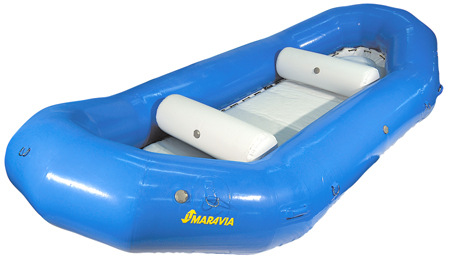
The Maravia Williwaw 2 whitewater raft. Source: http://www.maravia.com/index.php/main/product_detail/159/3
The Maravia Williwaw 2 is a half way point between the Williwaw 1.5 and the Mistral, while being more akin to the latter. The Willy 2 has the same 22 inch tubes, and 7’6 width, but uses only 3 stock thwarts, making it unusually designed for 6 paddlers in a nearly 16 foot raft. The Willy 2 is unavoidably a centermount craft, designed for multi-day use and oars. We used it as a stern mount paddle assist raft in high water and it did very well, in fact, better than the Mistral, but for all around use it’s just not suited well for Western Washington Whitewater when compared to the smaller tubed Williwaw 1.5.
Best thing about it: Excellent all around for private rafters in the Pacific Northwest
Worst thing about it: 22 inch tubes are awkward for paddling, and why only 3 thwarts?
Riken Nez Perce (now mfg. by NRS)

The Riken designed NRS E-162D "Nez Perce" whitewater raft. Source: https://www.nrs.com/product/1189/nrs-e-162d-nez-perce-self-bailing-rafts
Anyone who knows their raft design history knows that there was a time when Riken was the industry leader in raft design, and that design ethos was headlined by the multi-day all arounder, the Nez Perce, or the “Nezzie” as many of the guides called it. Hughes, a company that has decades of experience on the Middle Fork Salmon and Hells Canyon (amidst others) has shown the Nez Perce to be useable on a lot of different rivers, and it is still a favorite among seasoned professional guides. The original Nez Perce was flawed in one critical way in that the I beam design of the floor ran crossways in the front, causing unnecessary and excess drag; this wasn’t an overly prevalent design flaw because the rest of the rafts proportions were nearly perfect. The diminishing tubes performed excellently in the wind, the large side tubes carried a frame well, and the front and rear cargo areas made running self contained multi-day whitewater rafting trips easier than ever. 20 years ago the Nez Perce was the standard by which other raft designs in this class were judged, and the design itself was a game changer for the entire rafting industry. The Nez Perce design is now manufactured by NRS, using essentially the same material that was used in the traditional Nezzie. You can still not go wrong with investing in this big water, do-it-all, jack of trades raft design… and you can navigate whitewater rivers in style knowing that you’re rowing or paddling a piece of raft design history.
Best thing about it: You can literally do everything in this raft aside from run small rivers in lower conditions.
Worst thing about it: Is a basic design that has been improved upon since its inception. Is a better straight paddle raft than a stern mount (despite being often used as one).
Aire 156R (Sealed floor model)

Aire 156R whitewater raft. Source: http://www.aire.com/aire-raft/156R.asp
In the never ending search for a high water raft “crusher” at Triad River Tours, a raft that should be able to carry us through the dauntingly cold and challenging whitewater of May and early June, we ended up with a purple Aire 156R with a sealed floor. After the maiden voyage we had to replace a valve, which caused the raft to be removed from the Skykomish fleet for a few weeks; consequently we weren’t able to see this raft perform in it’s intended modality. Instead, by the time our new valve (ours had the archaic D7 valve and thus was a special order and not on our shelves at the shop) arrived and was installed, the raft was commissioned to join the Sauk fleet in fairly moderate river levels. We realize that this is unfair to the design, as it’s larger than the 156D, and thus we can expect similar results in high water, but because we don’t have data in high water, we are hesitant to infer the raft designs performance in big whitewater situations.
What we can tell you is that with an Aire raft, if you want to go with a larger raft, we recommend paying a little extra for the sealed floor. The Aire design with the ballast floor makes larger rafts with 8 loads lethargic, and while the rafts are marketed as having excellent “tracking”, we would argue that the word tracking could be replaced with “inertia”, meaning that you cannot turn the things once they are headed in one direction. The 156R raft with a sealed floor that we had was sportier than a non-sealed floor 156D, and thus, between the two, is our preference. This raft is very similar in performance to our beloved Maravia Williwaw 1.5, and had we been able to operate this raft design in larger whitewater, it’s possible that it would have unseated it as our fleet raft. We will put in another call to Aire to see if we can get “Barney” back up to Western Washington. For now we’ll keep this raft near the middle, and without a full data set we’ll just say that early feedback for this raft design was favorable.
Best thing about it: Handles great.
Worst thing about it: We never were able to test it in high water Class 4-5 whitewater conditions.
Avon 16’
NO picture. No longer manufactured. :)
While Avon no longer occupies the dominant position as market leader in whitewater raft manufacturing that it once did (having turned more to the salt water and open ocean market), the old Avon rafts are still very acceptable as large capacity rafts, and because they were made of such a durable material, there are many of these old rafts available in the used raft market. Many rafting companies from the 1980s and 1990s based their entire fleet on the Avon design, and as they upgraded to more modern rafts, these rafts went on sale, and you can thus find hundreds of these old relics rolled up in garages and basements of private river rafters across the USA. The Avon rafts were impressively light, and had amazing durability, while being fairly easy to patch; this is what made the Avon whitewater rafts so desirable for whitewater river outfitters back in the old days. But since the heyday of Avon, times have changed and the material is neither as light or durable than the urethane used by Sotar, and the design is no longer superior to any other standard round boat design. Still, one the busy weekends on rivers like the Gauley, Arkansas, or American, you will see these rafts being inflated for their customary token once per year runs, to be cleaned, obligatorily coated with Formula 303, and again rolled to await their next use a year later. The Avon rafts are a good purchase if you can find a used one for fewer than 2 grand, and such bargains are not completely uncommon if you peruse Craigslist or EBay long enough. It’s hard to go wrong with an old Avon.
Best thing about it: Good rafts that can be found at a bargain price.
Worst thing about it: You will have a hard time getting the outline of the previous outfitters logos off of the side of it.
NRS E-160

The NRS E-160 whitewater raft. Source: https://www.nrs.com/product/1095/nrs-e-160-self-bailing-rafts
The NRS E-160 would have to be considered the modern industry standard for all around 16 foot rafts. More desirable as a multi-day expedition gear hauler than a straight paddle raft due to the large diameter (22”) tubes, the E-160 has a formidable footprint on the river, and runs big water predictably while instilling confidence in less experienced guides. The E-160 is rock solid in every way and is a safe bet for any commercial operation, which is why you see fleets of E-160s from multi-day outfitting companies in Idaho and Oregon, to large commercial paddling fleets on the Gauley and New in West Virginia. The design is flawless and imminently standard, and the raft tracks well while carrying beautiful ferry lines across currents with efficiency that’s rare for a raft its size.
The E-160’s detriment in our operation is that the 22-inch tubes create difficulties for our paddlers who are equipped with 57-inch paddles. We use one length paddle for our 13-foot rafts all the way to our large 16-foot rafts, and thus, while this is a little nit picky, the E-160 isn’t viable for us as a high water whitewater “crusher”, and we prefer the E-161 to it for that specific task. For all around use, however, the E-160 is a better bet for most private rafters and commercial whitewater operations.
Best thing about it: Dominant big whitewater river “crusher” and excellent multi-day gear carrier.
Worst thing about it: 22 inch tubes make it obsolete as a paddle raft in Western Washington, and the size of this thing just looks awkward on our little coastal rivers.
NRS E-150

The NRS E-150 whitewater raft. Source: https://www.nrs.com/product/1088/nrs-e-150-self-bailing-rafts
Strangely enough the highly versatile E-150 is second on our list because it gives a western Washington river rafter the ability to run low water trips in technical conditions as well as tackle early season gaping holes and waves. The one issue that it has is that loaded down with 8 passengers (we have one that has thwart attachments for 3 or 4 thwart configurations) it becomes a missile that cannot be steered away from trouble. Like the scud missiles of Saddam Hussein in the OG Gulf War, the E-150 does not know where it’s going when there are 8 paddlers at the helm, and this is usually taking place on the Skykomish, Snoqualmie, or Sauk Rivers in May or June for us, when we really need the raft to react to guide decisions. The rudderless E-150 is best suited in these cases as a 6 load raft, and while that’s not preferable, it does exceptionally well with a stern mount oar rig, coupled with 6 paddlers in high water situations. While this isn’t as profitable of a configuration for a commercial whitewater rafting operation, it also gives us the added advantage of only having 6 swimmers in case of a flip (barring a superhuman dry flip, of course). The E-150 would be our choice for our fleet raft if we were not so in love with the Maravia Williwaw 1.5. It is important to note that between the two rafts, either can be special ordered with 3, 4, or 5 thwart attachments (with 5 thwart attachments the raft can be operated with symmetrical 3 and 4 thwart configurations). The E-150 and the Williwaw 1.5 are identical in every way other than tube diameter, with the Willy coming in at 21-inch diameter tubes and the E-150 with 20-inch tubes. The stock E-150 comes with 3 thwart attachments and the Willy 1.5 with 4. A 15 foot raft with only 3 thwarts isn’t viable for most commercial operations, and thus in a stock configuration the Williwaw 1.5 wins out for reasons of profitability. Still, the NRS rafts roll easier, and are about 20% cheaper. Additionally, the E-150s fantastic design traits can be had by the private boater by purchasing the Otter 150. At a retail price point of around $5,000 the Otter 150 offers tremendous versatility to a private boater, being lighter than the E-150 or the Williwaw 1.5, and being a little suppler and less durable. This is a mainstay design that is one that can accomplish a lot for a western Washington whitewater river rafter.
Best thing about it: Most versatile raft we’ve tested, and comes at a gentler price tag than the Williwaw 1.5 while having almost exactly the same performance characteristics.
Worst thing about it: Is almost as good as the Williwaw 1.5 but lacks the ability to carry 8 passengers in high water river conditions.
Maravia Williwaw 1.5

The Maravia Williwaw 1.5 whitewater raft. Source: http://www.maravia.com/index.php/main/product_detail/157/3
The Williwaw 1.5 is perhaps more popular in Idaho than anywhere else, where it can be seen carrying guests down anything from the Cabarton section of the Payette River to the large rapids of Hells Canyon, and everything in between. It tends to be overlooked as a “tweaner” design that neither excels at big water gear carrying nor as an 8 passenger paddle raft, but because we are a commercial rafting operation focusing on the tight, technical rivers of Western Washington, and because in higher water we are not opposed to running rafts with only 6 passengers, the Williwaw 1.5 occupies a serious sweet spot for us, and to put it simply; we love this thing. If you see a Triad River Tours trip, you’ll most often see us in these boats, in red, with our big blue and black logos up front. The rafts are durable, rigid, perform excellently, and work well in Class 3 whitewater like the Sauk, even with loads of 8 paddlers.
The Williwaw 1.5 is a tight fit for 8 passengers, and thus when used in higher water can get a little out of control due to inertia. If the Williwaw 1.5 could be made 6 inches longer, you would have a superb high water machine for the coastal rivers of Washington like the Snoqualmie, Skykomish, and Sauk Rivers. The rigid design make the Williwaw 1.5 perfectly capable of short waterfalls like Husum Falls, and in the case of multi-day traveling, it does very well with a center mount frame and 9.5 foot oars (we use shorter oars on more technical rivers, and longer oars on flatter, less technical rivers due to the potential for snagging).
The Maravia Cyclone is very simply the exact same raft as the Williwaw 1.5 but with diminishing tubes in the bow; this design functions specifically as a stern mount paddle assist raft on rivers where 6-8 passengers are being carried as a paddle team, and some extra splash is desired. Additionally, for center-mounted tasks, the Cyclone provides the exact same handling characteristics of the Willy 1.5, but has the added benefit of additional cargo capacity in the front, while being a hair lighter, and having added visibility looking downstream. However, it may be important to note that the added splash of the Cyclone isn’t typically desired in the frigid waters of the Cascades, which puts our guests in even more hypothermia risk, and the Cyclone will not have the big water capabilities of the Williwaw 1.5 in situations where there are steep drops as the diminished front end on the Cyclone is quite low and has a tendency to “spear” into the waves, providing a fun splash and an adrenaline rush in Class 3 water, but on rapids like Boulder Drop of the Skykomish can cause the raft to literally “endo” by spearing underneath the foam pile after the infamous drop of the “picket fence”. The Williwaw 1.5 is thus our choice for Western Washington whitewater, while being notably similar to the Cyclone raft design in every dimension but one, crucial aspect.
The Williwaw 1.5 has one distinct disadvantage in Western Washington that may come as a surprise to many, and that is that the geology of the Cascade Mountains creates river rocks that are porous and granular; there is a faster wear factor on Maravias on these rivers that we have noticed. On the proverbial flip side (pun intended), Maravia has excellent warranty service and is a great company as far as relationships, and they stand fully behind their products. The Williwaw 1.5s excel for all around use on coastal rivers, and while they are slightly large on the river in comparison to 14 foot rafts, the Williwaw 1.5 is exceptionally and impressively nimble; this design turns on a dime, and the 21” tubes give it more carrying capacity than the aforementioned E-150. The Williwaw 1.5 is the ultimate all around raft for Washington Whitewater in our opinion, and while it’s at a higher price point than most of the other rafts on this list, the 10 year warranty and performance of the design give it our nod as the best in class.
Read more:

14 foot whitewater raft comparison shootout
Comparing 14 foot long self bailing whitewater river rafts.
The 14 foot raft is, to the whitewater river rafting industry, the swiss army knife of rafts. The 14 foot raft carries 6 people plus a guide with ease, and can be configured to carry 7 people plus a guide or a stern mount paddle assist in the rear, with 6 paddling guests, with ample paddling room between them, to create a truly dominant whitewater craft in both big and technical river rafting conditions.
Here in Western Washington we often opt for the more slender 13 foot raft because we typically have larger 15 or 16 foot rafts for early season rafting conditions, and use the smaller rafts exclusively for lower water conditions. A 13 foot raft edges out the 14 footer because it’s slightly narrower and more suited for the task in more technical water, but across the world, many companies run their entire fleet based on one 14 foot design, and as far as rafting with groups of 6 river guests, the 14 footer is the standard.
We certainly have not had enough rafts in this category to proclaim that we have done a full comparison. Popular and undoubtedly proven rafts in the 14 foot category are omitted from this list simply because we do not have experience with them. Still, we feel it may be useful to share with you our in house comparison of all of the 14 foot rafts we have used. Just like our other analysis, the most important factor is usability in the conditions facing the guides; that is to say, we pick first the raft that the guides like the best and gives our guests the best ride in the river rafting conditions that the raft was designed, and thus we intend to use it for. Next, we consider the cost vs. value of the raft. If the raft is fantastically designed but made of an inferior material, we are going to grade it down (especially considering that for commercial use the rafts are going to get some serious mileage in a short time). The last metric we use is if the guests can tell a difference. Here, how the raft looks and feels to our guests will influence our grade, but far less than the other two metrics. Onward! All Forward!
1. Maravia Williwaw 1
2. Maravia Ranger
3. NRS E-142
4. Aire 143D
5. NRS E-140
6. Maravia Diablo
7. Aire 143R
8. Super Duper Puma
Super Duper Puma

The Aire Super Duper Puma. Source: http://www.aire.com/aire-raft/super-duper-puma.asp
The Super Duper Puma is the equivalent of a long bed pickup with a 4-door crew cab. It’s essentially a Super Puma stretched out to another foot without adding a whole lot of width. The raft is incredible for certain, highly specific river conditions. It carries 6 people with much more ease than does the Super Puma, but in technical water simply does not hold a candle to it’s smaller sibling. The Super Duper Puma is, also, very similar to the Aire 143D, but narrowed down to fit tight slots. Looking at this design from that angle gives it perhaps a more fair comparison; the raft can drop tight slots with 6 people. Kind of like the hilariously named “Hot Dog Bun” raft made by Hyside, the Super Duper Puma is capable of extending the seasons of raft trip outfitters that operate on rivers where the river channels out between boulders creating tight slots that the guides have to fit through, and if you run it with too wide of a raft you will simply pin there dangerously and embarrassingly. The Super Duper Puma flips much easier than a 143D and is not adept at running the same kind of big waves that it’s larger sibling does. It is, in just, the largest of the Puma line, and offers incredible value, being significantly cheaper than the 143D (and priced closer to the Super Puma. The SD Puma is also proven as a center mount raft in big water; perhaps this is where the design functions most impressively. If you can rig one of these rafts with a center mount frame, or a fishing setup for fly fishing on coastal streams, and keep the weight down, it still turns well, and has a design that is reminiscent of a driftboat. The SD Puma just didn’t fit out system like the 143D, and that’s why it’s at the bottom of our list… it’s a specialized design, and for those who have the right situation; it can be made to be a perfect raft in the right system.
Aire 143R
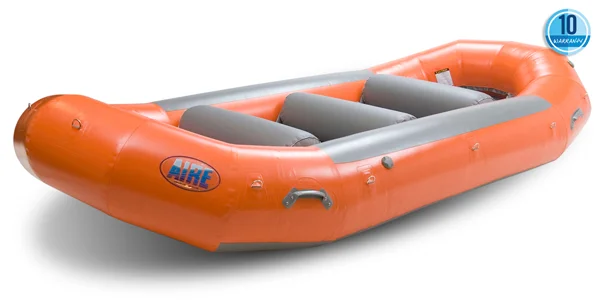
It is difficult to be placing one of the most popular whitewater river rafts in the USA as our second to last favorite boat. The 143R, which we ran for a full season, produced a resounding, “what do we do with this boat” response from our guides. It has the width and stability of larger rafts, per the norm of the R (round) series, by Aire. The 143 is a perfect size for 6 people, and when coupled with a stern mount frame and oars, ran big water very well. So why is it so low on the list? Simply because with the sluggishness that it has, it’s better to run a 15 foot raft. The 143R is big, and on the river it feels heavy and carries it’s momentum and is thus hard to turn. For us, we already have larger rafts for big water conditions, so a 14 foot raft that doesn’t turn well is a death sentence. The 143R would be a great choice for a private rafter and 2-4 people plus gear on a 3-4 day multi-day rafting trip. It is very stable, and predictable. For us, as a paddle raft, it just didn’t cut it.
Maravia Diablo

The Maravia Diablo whitewater raft. Source: http://www.maravia.com/index.php/main/product_detail/153/7
The Diablo is another raft that is perhaps surprisingly low in our comparison. Chris Frazee at Maravia, sent us over two of these during one of our seasons and we got a lot of use out of them. The raft design looks, on land, like it’s fast, sleek, and would turn on a dime. We have even asked guides at other companies that use the Diablo (it is perhaps the most popular Maravia raft design in Washington as far as commercial rafting use), and they all feel that it turns well. We can’t figure out why guides at other companies have had such a different experience than our staff did, but here’s what we found.
The Diablo is essentially a Ranger with diminishing tubes, or you could also look at it as a Williwaw design that has been narrowed and added to it diminishing tubes. It can be used as a stern mount raft, and perhaps does better as such, for technical rivers. The diminishing tube front doesn’t overly splash the front paddlers, and the tubes are grippy for paddlers butts. The Diablo doesn’t flip as easily as one might expect, and it handles big water well. The issue? Fully loaded with a paddle crew and one paddle guide, the Diablo doesn’t turn well in technical water. There is a certain squareness to the footprint that the raft has on the river; there is, thus, a bit of a drag coming from the corners of the raft when quick turns are made. Conversely, if you think about the Aire 143D, an almost identical raft design from a proportions standpoint, these corners don’t exist. This might seem like a detail, and it is, but it’s enough to drop the Diablo to the bottom of the list because it simply doesn’t have the needed leverage to turn in technical rafting conditions, and if used with a stern mount frame, we prefer the design of the Ranger (essentially the same raft as a Diablo but without diminishing tubes).
NRS E-140

The NRS E-140 self bailing whitewater raft. Source: https://www.nrs.com/product/1085/nrs-e-140-self-bailing-rafts
The NRS E-140 is a stout little boat. It’s the widest 14 foot raft that we have ever tried, and its large tubes and wider stance make it a big water favorite. The E-140 isn’t flippy, but once upside down you better be on your game or have some kind of flip line rigged to the bottom of it, because it’s tall. Staring at the E-140 from the river, it looks impossible to climb on top of. It’s as stable as a 15 foot raft, and it rides high in all conditions. The E-140 is thus a little bit of a “tweaner” because it’s an amazing gear hauler, similar to our 15 foot raft designs (we use the Maravia Williwaw 1.5 which has the same 7’ width as the E-140), it offers no benefit as a paddleboat in technical water or rapids with tight slots. Thus, the E-140 is an excellent private boater raft, as it excels with a centermount. It’s also proven as an R2 raft despite being huge for the task; as long as you’re ready to throw in a high side, the E-140 will get two people down river in style. The E-140 doesn’t fit our purposes mainly because it just doesn’t have the sporty factor as other designs. For the same money we can be running the NRS E-142, which is more adept at 6 load paddle crews.
Aire 143D

Aire 143D whitewater raft. Source: http://www.aire.com/aire-raft/143D.asp
The Aire 143D whitewater raft is a different animal altogether than the Aire 143R when it comes to on the river performance. The 143D is fast, turns well as a straight paddle raft, and the design seems to be able to handle lower water as well as river conditions that demand stability in big waves and holes. The 143D is used by several commercial whitewater rafting companies in the Pacific Northwest. The designs rigidity makes it a nice raft to take over Husum Falls on the White Salmon River, and the continuous rocker make it fun to take down chutes and technical sections like the Sauk or Nooksack in lower water. The 143D is probably the most versatile design for Washington whitewater; it works well as a paddle raft or as a center mount oar rig. The D series as a whole doesn’t do well with a stern mount frame; it’s simply too low to the river to be effective, and guides are constantly getting punched in the ribs by their oars which, due to the diminishing tube design, are positioned with the handles right in front of your rib cage. The 143D is not a stern mount raft design. The other drawback of the design is that it is a very wet raft, and in river conditions like that on the Skykomish’s Boulder Drop the 143D can “spear” into the river when going over steeper drops. We wouldn’t go so far as to call the 143D a “Class 4 raft” as it’s clear that it’s capable of running bigger water and larger waterfalls, but only when there is a smaller crew of more experienced paddlers. The design works exceptionally well for our rivers, and if a private boater wants to run multi-day trips on the Rogue River, the Middle Fork Salmon River, and then have a fun playboat to use on coastal rivers with friends and family for a day of paddling; the 143D is hard to beat as a versatile all around raft.
NRS E-142

The NRS E-142 whitewater raft. Source: https://www.nrs.com/product/1084/nrs-e-142-self-bailing-rafts
The NRS E-142 is a hidden gem among the NRS raft lineup. It fills an important void left behind by the bolstered, overly stable, ant-sporty, wide as a trailer house E-140. The E-142 is a more classic design than the 140, and it handles Western Washington whitewater better. It isn’t as stable as the 140, but it paddles better, and has a more pronounced bow and stern, making it an excellent raft for steep drops. The E-142 isn’t the gear hauling monster that the 140 is, but it does well as a center-mount raft, and excels as a fishing craft. The lines of the E-142 are very similar to that of the Maravia Ranger, albeit slightly narrower. This is a raft that we really loved, and was difficult to move on from. Had Triad River Tours opted to build a fleet with 14 foot rafts, it’s likely that the NRS E-142 would have been the one. We also feel it important to note that we have not tried the Sotar ST ’14 nor have we tried out the Hyside 14 foot rafts; both of which have design factors very similar to this one; it’s possible that we would have loved all of them, but since the E-142 is the one we have had on several whitewater rivers in Western Washington, it’s the one that we recommend highest of all of the NRS boats in it’s class.
Maravia Ranger

The Maravia Ranger whitewater raft. Source: http://www.maravia.com/index.php/main/product_detail/156/3
The Maravia Ranger 14 foot raft is almost identical in proportions to the Diablo, but performs drastically differently. The Ranger is unique in that it handles steep drops incredibly well, can fit into narrow shoots, and can be used equally well as a straight paddle raft, or as a stern mount paddle assist. The Ranger has been used by outfitters on technical rivers like the Payette, and can also be seen in videos of running the Main Salmon River at 80,000 cfs. The Ranger is a performance marvel because it’s upswept bow serves as an excellent casting platform for fly fisherman; it is thus incredibly versatile and for Western Washington rivers, where we do not need excessive splash from the frigid glacial river water, the high rocker design is excellent for running technical and steep rivers. The Ranger is not as adept at being configured into a multi-day system as the bow catches the wind like the Santa Maria; the ranger is also not a common design, so if you want one the used market essentially doesn’t exist. Buying one is usually a special order from Maravia (especially if you want a specific color), and you’re probably going to have to go into it blind. Triad River Tours was unable to get a Ranger demo raft, but our guides have used them while working for other companies, and this review is based in rafting experience on commercial rafting trips. The Ranger is also a fairly expensive niche raft… why it isn’t more popular is hard to figure.
Maravia Williwaw 1

The Maravia Williwaw 1 Whitewater Raft. Source: http://www.maravia.com/index.php/main/product_detail/158/3
Years ago one of our guides was in conversation with the would-be president of Maravia, Chris Frazee. Chris was asked what the ultimate raft was in the Maravia lineup and he right away responded that the Williwaw 1 was their best, most versatile raft for private rafters for all purpose paddling. This is somewhat shocking considering the diminutive design in comparison to the rest of the Maravia raft lineup (the Williwaw series essentially starts with the 1 and gets bigger from there). The Williwaw 1, nonetheless, is quite simply the perfect all around boat. It is at home as a centermount gear hauler on multi-day rafting trips. It does well as a stern mount raft on difficult rivers like the Lochsa or Skykomish, and it is a great paddle raft and has been proven as a fleet raft for large commercial whitewater rafting operations on Eastern Rivers. It’s not cheap, but there are more Williwaw 1s out in the used raft market than any other Maravia model. Thus, the Williwaw 1 is an easier investment for the private rafter to make because of resale value and ease of resale. The Williwaw 1 has a classic design, and perfect proportions as far as width and length, and the 20” tube has to be considered the best tube diameter for paddlers. The raft offers great splash, it turns easily even when weighed down with 6 paddlers, and just offers something for everyone. The Williwaw 1 is our favorite raft. We use it’s larger sibling, the Williwaw 1.5, for most of our commercial whitewater rafting activity, but give a nodding glance to the similar 14 foot model, and feel it’s the best overall choice for Western Washington Whitewater rivers.
Read more:

Safety kayaker vs. Safety cataraft
Investigating the advantages of safety kayakers and safety catarafts on professionally guided whitewater rafting trips in Washington State.
Perhaps no debate rages on with more fervor at a campfire surrounded by professional whitewater guides than whether or not a kayak or cataraft is a superior safety boat. There is a clear correlation between guides that kayak and preferring a kayak, and guides that cannot kayak but have extensive rowing skill, and the preference for a cataraft. Which one is the best is mostly subjective, and does often depend on the skill set of the guide themselves, but we’d like to point out some common sense approaches to this situation just in case you’re about to launch a whitewater rafting expedition and have to choose between an adequately trained kayaker and a seasoned oarsperson running a cataraft.
Safety Cat Advantages and Disadvantages

The 14 foot Aire Wave Destroyer is a popular safety cataraft on guided whitewater river rafting trips. Source: http://www.aire.com/aire-cataraft/wave-destroyer-14.asp
Catarafts are above all things, people catchers. The cataraft is at home waiting in a pool below a large rapid, and they are adept at pickup up swimmers before they are lost downriver. For this task, particularly in a commercial setting, the cataraft is the clear winner compared to a kayak. Catarafts have over a thousand pounds of positive buoyancy, and have the ability to get the swimmer completely out of the river; they also have a distinct advantage when it comes to rescuing unconscious swimmers. Overall, the thing to consider with catarafts is how many people you plan on retrieving out of the river; if it’s a high number, and you have a guide that can consistently and safely navigate rapids alone and wait below the trip in the best spot, then the cataraft is the best option, undeniably.
Catarafts are at a distinct disadvantage in almost every other capacity (get it; capacity!?). They are slower than kayaks; and yes, we realize how fast catarafts are for people that are used to being in a raft, but there is absolutely not comparison to a kayak. As a result, if there are swimmers in multiple locations, it will take longer to get to them in a cataract.
Catarafts can carry more equipment, and supplies like a spine board, pin kit, and comprehensive medical kit are much easier to carry on a cataraft than in a kayak. Furthermore, if there is an emergency and a 911 call has to be made, a guide can do so from a cataraft from within the cockpit. While kayakers can keep a cell phone in their PFD, it’s more likely that the evacuation phone and medical kits are stored within the kayaks bulkhead, and thus, the kayaker may need to paddle to shore in order to access them; this could require precious time in an emergency that is not lost when a safety cataraft can simply reach over to the evacuation kit and dial 911, and have a conversation from within the cockpit of the cat.
Catarafts operated by competent and experienced guides also have the advantage of being able to carry a second guide with them, or carry an injured paddler down river. In a case of a raft that was left by rivers edge (perhaps in a case where another guide was injured), catarafts can transport another guide downriver to then meet the abandoned raft. A 14-foot cataraft can carry up to 4 people downriver in class 3 rapids, while a kayak is unable to carry anyone. Catarafts can also carry larger items like hypothermia prevention gear, an extra pump, and in some cases an extra guide.
A major real world downfall of safety catarafts is that they are commonly operated by the lesser-experienced guides, but not always. This is a logical decision commonly made by the trip leader; to put the most accomplished, more experienced guides with the guests or paddlers (in case of a private trip), and the lesser-experienced guide with the cataraft. In this case there are two problems. The first, is that there’s an overwhelming risk being taken by the guide going first through the rapid, and as a result, it may be wisest to have the cataraft run the rapid with the rafts; first, for sure, but still not far enough ahead to provide proper support for the rest of the trip, and certainly not in case of the raft immediately behind the safety cataraft being involved in a flip. Additionally in this instance, it is almost always better, in severe whitewater like Boulder Drop of the Skykomish River, to have the cataraft waiting below the rapid in the spot most likely for swimmers to end up; this allows the cataraft guide the advantage of being able to predict where the swimmers will end up, and get a real birds eye view as the rafts come down as to which swimmer will be, or is in the most dire situation (obviously the safety boater is required to retrieve the swimmer in the most danger first; often this is the furthest down river swimmer). Granted, during scouting, the lead guide can explain to all paddlers where they would be best swimming, but there is absolutely no telling where a swimmer will end up at the bottom of a class 4 rapid. As a result, there is a simple matter of economics at play here that on commercial trips you often necessarily (but not always) have the lesser-experienced guide in the position of a rescue guide.
Catarafts also have the disadvantage of being heavier, and when they flip they can injure the guide. In rare cases, if the cataraft flips (and they will), the guide could lose the boat. If the boat is lost downstream, then the remainder of the trip is going to be run without the safety raft. While this may be rare, we assure you that it has happened many times on commercial rafting trips, and for some reason it happens in the worst rapids and at the worst times. Catarafts are very forgiving, but in big water, with lesser-experienced guides rowing, they can and will flip, and in those cases the proverbial wind can come out of the sails of everyone else in the paddle crew if they witness it. As soon as the cataraft flips below, the attitude and tenor of the rest of the rafting crew changes, and not only are the guests aware that their safety boater has just flipped, but there is a legitimate danger increase to themselves and to the trip as a whole. The demoralizing effect of witnessing a flip is something that many professional whitewater guides have experienced, but many private rafters have not. Within a split second, a paddling crew can go from smiles and laughter to complete and utter despair and fear. If people have never witnessed a raft flip and they see the safety boater flip ahead of them, their psyche immediately, in some cases, goes directly into panic mode, and now you have a team of paddlers that was inexperienced and optimistic, to a team of inexperienced paddlers who are distracted and afraid, and as a result, you have a much less capable paddling crew. While this situation may seem like a detail and a rare exception, the reality is that it’s likelihood is one that has some of the harshest consequences, and in real life situations is more common than it would appear. Safety catarafts come with them many responsibilities, but none as vital as keeping a raft that can flip over easily, right side up.
Kayak Advantages and Disadvantages

The Pyranha Shiva is a popular safety kayak on commercial whitewater river rafting trips. Source: http://www.pyranha.com/kayaks.php?kayak=shiva
Kayaks have several advantages over catarafts, and if you start thinking deeply about it they will start to add up fast. One of them is that a kayak in the hands of an experienced and trained class 5 safety kayaker (like those we have at Triad River Tours) becomes an incredible asset from a preparations standpoint. For example, a legitimate safety kayaker can easily run a class 3 river alone without issue (assuming that they are familiar with it), they can scout the river the day before the guests get there and take video of the rapids so that the other guides can study this video as part of their pre-trip briefing. Kayakers of this kind can be relied upon to navigate a river at over twice the speed as a cataraft. If you ever doubt this just look up YouTube videos of the sickline race, or the North Fork (Kayaking) Championships. Class 5 kayakers are incredibly fast and adept at running intense whitewater, and most class 5 kayakers are highly trained and do not need to scout rapids that may cause a cataraft guide to pull over and scout, wasting precious time in a rescue.
Kayaks are highly mobile. If a safety kayaker does spot a logjam on a scouting run, the kayaker will usually have no problem eventually getting clear of the obstacle. Kayakers are usually self-taught in belaying and getting themselves up and over or around logs or other obstacles using nothing more than a throw rope and a small hand held pin kit. Speaking of pin kits, while kayaks definitely pin, a professional safety kayaker is far less likely to be a liability of any kind when compared to a cataraft. Even a fully competent veteran guide at the oars of a cataraft could pin or wrap their cataraft amidst difficult whitewater, and while this is also possible in a kayak, it is much less common, and the consequences are far less dire.
Kayakers are usually on the river a lot on their days off, and this is a strange and obscure advantage that will not doubt draw the ire of many avid cat boaters, but from the perspective of risk management and overall trends, kayakers are on the river more than rafters or catarafters, and therefore they are more familiar with the sections of river which they run, and they are generally more familiar with their craft (safety kayakers at Triad River Tours are compensated at a rate that considers that they are using their own equipment, while safety catarafts are usually supplied by the company and therefore the guides that use the safety cataraft are less familiar).
Safety kayakers can also flat out run more difficult whitewater. At the end of the day it is true that most of the difficult whitewater in the world that has been kayaked has also been run by an inflatable, but the statistics are astoundingly in favor of kayaks being the undisputed kings of whitewater supremacy. While there may be one or two catarafts that have ran the famed Grand Canyon of the Stikine, there have to date been hundreds of descents done by kayak. Class 5 kayakers seem to feel at home in the worst conditions, whereas catarafters are just not quite in as dominant of a position. As a result there is less risk involved in hiring and utilizing professional safety kayakers in most situations when compared to safety catarafts.
Conclusion
Making a choice between a safety cataraft and a safety kayak should be made with common sense and reason, and should start with the skill set of your crew. If you simply lack a qualified safety kayaker, then you have your answer right there. Also, consider that if you are running a trip that has 4 or 5 rafts, and you are deciding between one of the two, consider that most things you can do in a cataraft you can also do in a raft. Granted, you are having to utilize whoever is in the raft and putting them potentially in danger by involving them in a rescue, but there is no doubt that if you have several rafts and a kayak, you have the ability to perform a wider variety of rescues than if you have several rafts and a cataraft.
The endless debate rages on, but for us at Triad River Tours we always start with our personnel; if we start the day and at the pre-trip meeting we have a competent rescue kayaker, we use them. Hands down that’s our choice if we have the luxury. We know that by choosing a kayaker that there are a couple of situations where we would be better off with a cataraft, and we also know that there is a probability that we could encounter those situations and have a disadvantage as a result of the decision. We also have to account for the quantity and severity of inabilities that catarafts present, and that if we happen upon any one of several river rescue situations where the kayak is preferred, that we will be at a disadvantage. The best thing to do is continually train yourself as a private rafter, or as a professional guide or outfitter try and hire both competent oarspeople as well as great kayakers. If you have the money to spend, make sure to attend an SRT-1 course, preferably by Swiftwater Safety Institute, and if you are planning on working professionally as a safety kayaker, attend on of SSI’s PSK (professional safety kayaker) courses to learn specific skills relevant to safety kayaking. At any rate, the best rescue is one that was done preventatively; keep the bow pointed downstream and when in doubt scout. Catch you on the flip side friends.
Read more:

Small Paddle Raft (12' and under) R2/R4 shootout
An investigation into smaller, self bailing, whitewater river rafts. The best rafts we have used for R2 on steep whitewater creeks.
Little raft shootout
Everyone loves little rafts, and we are no different. While the guides are usually working from the rear or larger rafts, these are the boats that we use on our off days, the rafts used for little creek expeditions, the boats used to test material of manufacturers, and the ones that we just like to throw on top of the guide vehicle (a 2016 Toyota Tundra) and just take off and have some fun. These rafts are increasing in popularity and we look forward to updating this list with rafts that we have not yet tried (and so please be patient with us; we are aware that there are several raft designs that are notably missing such as; any of the small Sotar boats (they’ve been cost prohibitive for our guide fun budget), a Star Lightning Bug, a Tributary 12.0, Hyside Mini Me, Maravia Seal (Dear Manufacturers: send us one!). We don't review rafts that we haven't had in our system, but we do look forward to getting more experience with newer designs or models we haven't had the opportunity to use; as we do that we'll update our analysis.
1. Aire Puma
2. Hyside Mini Max
3. Original “Shredder”
4. NRS Giant Slalom
5. Aire Sabertooth
6. NRS E-120
Aire Puma
The smaller sibling of the Super Puma, the original Puma is about 11 feet long and really has no commercial viability for us at all. Still, we’ve had some good runs in it. The Puma excels as an R2 raft, and just really dominates running technical Pacific Northwest creeks. The boat has amazing stability for it’s size in comparison to others on this list, partially due to the ballast floor. What makes the Puma the first on this list is the ability to easily move the position of the thwarts to adjust for paddlers different positions in an R2 situation. We vote the Puma as the finest R2 raft for our purposes which essentially constitute following some great kayakers down water that really doesn’t favor the clumsiness of most rafts. The material is stout, the design impeccable, and it’s a reliable and predictable ride in the toughest and steepest technical whitewater around.

Aire Puma Whitewater Raft. Source: https://www.nrs.com/product/1162/aire-puma-self-bailing-rafts
Best thing about it: You feel like you’re flying a very small airplane through the winding canyons of the Amazon when you’re running tight technical whitewater, and it will essentially change your life.
Worst thing about it: You have to lace the floor in yourself (?)
Hyside Mini Max (Neo version tested)
There’s good and bad news here to report. The good news is that we had a lot of fun running this cute little whitewater thrasher, the bad news is that we (the guides) did a lousy job of strapping this little guy to the top of the Tundra and it flew off driving down HWY 20 (North Cascades Highway) going about 60. Needless to say Hyside sent us contact info for a guy that could fix it (Thanks Zack @ raftrepair.com). The raft ran beautifully for us on the Sauk in high water, and was every bit what we expected. It is noticeably lighter than the Puma and a little more squirrely, requiring a more attentive paddle attitude. The Mini Max is perhaps a little more suited for a tiny little centermount frame and use as a low water rescue raft. It’s a great R2 raft, but it does tend to get stalled, as you may expect, when running bigger holes. Unlike the Puma it does not carry much momentum into anything; a problem that is erased when the gradient is steeper. The D-rings and construction are impeccable, and the lines of the thing are just really nicely drawn out. This is our choice as the best hypalon (okay so Neo isn’t actually Hypalon, but it’s so similar you’ll be hard pressed to tell the difference) raft in it’s class. If it were not for the astounding performance of the Puma, this would be first on our list.

Hyside Mini Max Whitewater Raft. https://hyside.com/product/outfitter-10-5-mini-max/
Best thing about it: Performs like a perfectly designed little raft that requires no getting used to in order to run effectively.
Worst thing about it: Will puncture if it flies off the roof of your pickup going 60 MPH down the highway. We used, with great success, a 54 inch wide NRS Longhorn frame, and ultimately decided that 8’6 oars were too long for tight water, and that 7’6 oars were too short, and so 8’ oars were just right (like Goldilocks, in a way).
Original Shredder
For those that have owned an original Shredder or a design similar enough to warrant the name, you already know that this design has an advantage over any whitewater designed round boat. The Shredder is an East Coast marvel that has only recently made it’s debut in Western waters (we say recently because there are some old timers here; think late 1990s). The Shredder is an R2 machine, that really excels at that and only that. It really was not made to have a frame on it, and unlike some of the newer designs from Hyside and Aire, it was made out of a simple black neoprene rubber. The boat was kind of unstoppable and has a reputation for a reason, and the name is well deserved; when you’re paddling one you truly feel like you’re shredding. The original Shredder and some of the recent renditions of the design by other manufacturers (notably Hyside) had an advantage of being so light and compact of a design that it could be folded up and carried with ease; many guides have taken their Shredders on their off days up in the hills beyond the furthest available put-in to run water that was perhaps previously consider off limits to everyone but kayakers. The Shredder is impressively maneuverable, and is a great investment for people that like to R2 because as you own it, it seems to evolve with you as your skills progress; meaning that novice paddlers do well with the design because it’s forgiving, and expert paddlers enjoy the Shredder because it rewards more experienced paddlers with the designs capabilities in steep, technical, difficult water. The Shredder is likely the most capable technical R2 boat on this list, but because it’s limited to only one intended use, it’s third on the list (aren’t these lists somewhat arbitrary, though?). Keep in mind that we are a commercial outfit, and thus we really have no use for a Shredder because we can’t use it as a safety cat (it cannot fit a frame), and we certainly can’t afford to have two guides running safety on one raft that can only carry 2-3 swimmers in a bad situation. The end result is that if you can find one of these for a good deal; buy it. They’re awesome, and anyone who owns one and uses it will rave about it for good reason. They have a cult following because they do things that no other inflatable can do.
Best thing about it: Cataraft performance in a boat with no metal to break your arm.
Worst thing about it: Cannot be used as an oar boat (so what?)
NRS “Giant Slalom”
At the end of our 2017 year Northwest River Supply sent us what they call a Slalom. We asked “you mean the 120?”. Nope; this is it’s own boat, and upon inflating it you could tell immediately that this was going to be fun. Slightly bigger than the Mini Max, and almost exactly the dimensions of the Hyside Max 12.0. So think of a scaled down E-120, and there you have it. The Slalom is slightly bigger and thus less maneuverable than the Mini-Max, but not by much; the NRS material seems to thrive in this design, whereas the E-120 was always so wide that it was a bit sluggish. Here you have a raft where in an R2 situation you are a healthy distance from your other paddler, and can still fit between tight slots on steep whitewater. We are planning on taking this little raft on some more difficult training and protocol runs in the spring, and have utter confidence in it’s ability. It also does really well with a small NRS centermount frame. We used the same 54 inch NRS Longhorn Raft frame, and prefer the 8’ oars. With the ever expanding small raft market, it only makes sense for the Slalom to become the NRS competitor to the Mini Max/Max 12.0 and other small rafts that are getting a lot of attention on Facebook and Instagram (who doesn’t like watching two paddlers send a 20 foot waterfall in a raft the size of a twin mattress?).

NRS Giant Slalom Whitewater Raft. Source: https://www.nrs.com/product/1035/nrs-giant-slalom-self-bailing-raft
Best thing about it: Legitimately could be the only raft a private boater would ever own, as long as there’s only 2 of you.
Worst thing about it: Ours is blue, and we are sick of blue.
Aire Sabertooth (12.0 Frameless Cataraft design)
We were uber-excited to get our Sabertooth and perhaps one of the reasons it’s rated behind some of the other more basic rafts is that we really thought we had the boat that would be dual purpose R2 for guide training, and late season safety cat for our Sauk trips. The reality was that we had a boat that was a little bit cumbersome to R2 in comparison to a Shredder, and a boat that was not quite as sure footed as our other 12 foot long cataraft. The nice thing about the Sabertooth, obviously, is that it can do both, but it doesn’t do either exceptionally well for a commercial operation, and here’s why. For us, we need to be able to train our guides to paddle, and rookies would do fine in this design, but then the skills weren’t directly transferable to a raft; okay that’s not the fault of the design, but consider that you can take a Shredder and fold it up into a package the size of a backpack, and this design (which is approximately twice as large) isn’t going to work as a high mountain packraft alternative. As a commercial operation we also need the craft to be nimble, and the reality is that a 12 foot cat with a frame (we use a 12’6) is just a lot more capable in serious whitewater than the Sabertooth. The narrow gait of the Sabertooh causes problems turning in bigger water with 8’ oars. We love the concept and design, and the Aire boats are tough as nails. We also like how the boat rescues people; unlike a typical cat there is a floor for swimmers to lay down in and catch their breath. In many rescue situations the Sabertooth would be superior because of the floor and ability to rescue a worn out or unconscious swimmer/victim. It’s a great boat, but we wish it was lighter, and wider.

Aire Sabertooth. Source: https://www.nrs.com/product/87030.01/aire-sabertooth-frameless-cataraft
Best thing about it: Can replace both a small raft and a small cataraft for under $3,000.
Worst thing about it: Cannot replace a shredder for portability, and cannot replace a legitimate cat for performance.
NRS E-120
It is with great reluctance that we put one of the OG, legitimate, most proven small rafts at the bottom of this list. We remember running the E-120 on the Gauley when the guides went out for fun runs, and we remember making it. This is as sure footed of a small raft as you will find; maybe a little too sure footed. The issue with the E-120 raft is really quite simple; it is so wide, and it’s thwart configuration so awkward, that it seems to struggle with itself for purely logistical reasons. It does best as an R4, with two paddlers ahead of, straddling, or behind the front thwart, and two paddlers undeniably behind the rear thwart. The E-120 is a proven whitewater raft that has a much longer track record than any of our other boats for commercial whitewater use. The E-120 is also very useable as a centermount raft. Perhaps the problem with the E-120 is that it is ALMOST big enough to use commercially, but it just can’t match an E-130 for commercial use, and cannot match the performance of the Slalom or the Hyside boats for R2ing. At the end of the day, the E-120 has an identity crisis that caused us to get rid of ours. We respect this little guy for all that it can do, and we think that if you have some smaller rivers and want to run multi-day whitewater rafting trips, then it’s going to be a great choice, but this list is mostly about fun and R2ing, and for that it’s the least favorite. Note: The NRS E-120 raft has since been redesigned since the time of this writing; we will update the review once we use the new model.
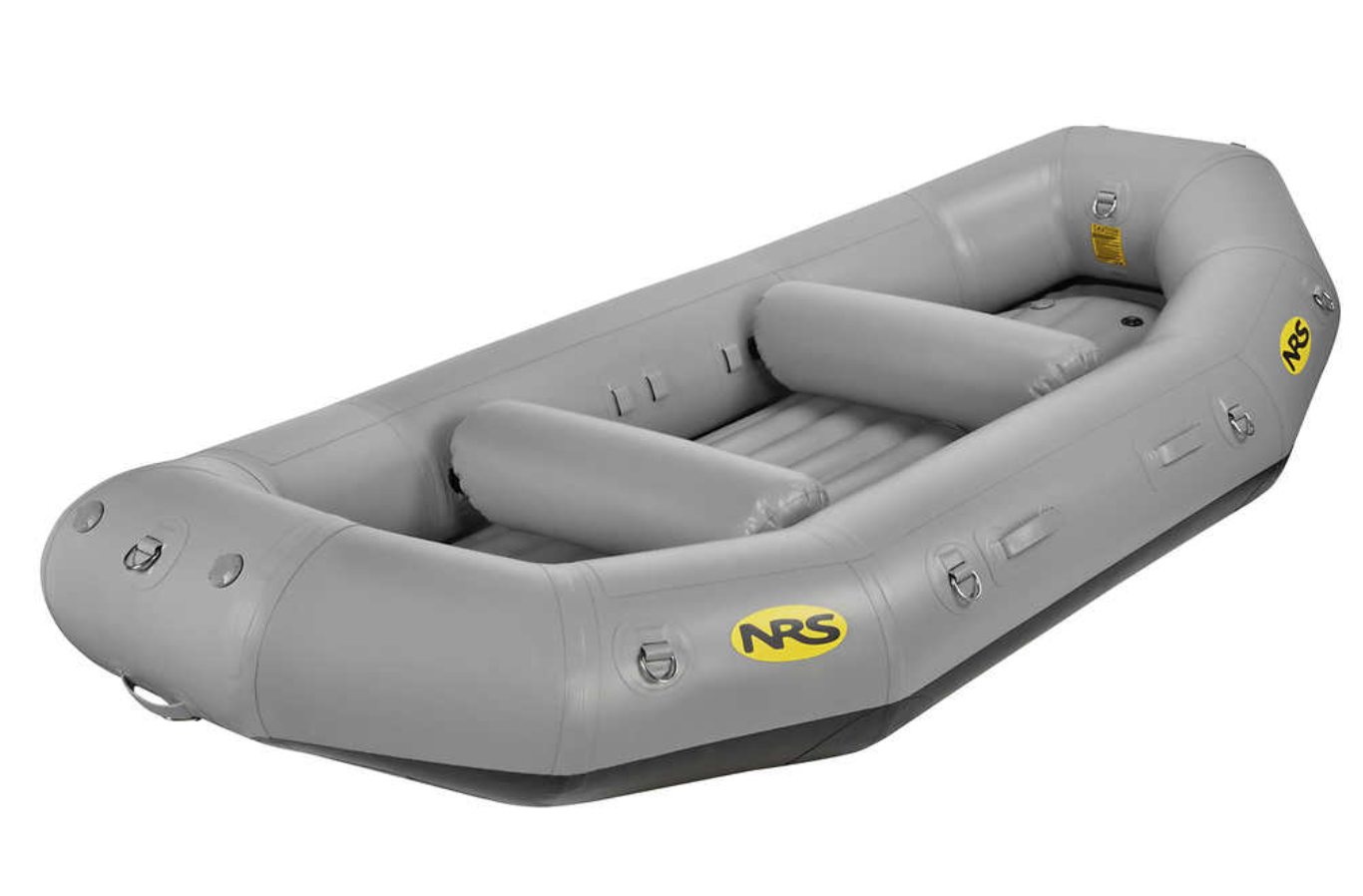
The NRS E-120 Whitewater Raft. Source: https://www.nrs.com/product/85037.01/nrs-e-120d-self-bailing-rafts
Best thing about it: Is a great centerframe raft, and is proven as a commercial raft.
Worst thing about it: The tubes are too small and it’s too wide to keep up with the others as an R2.
At the end of the day, the smaller the raft, the more individual preference becomes the primary factory for the decision; more personal boats that are reacting more directly with your body movements. In our situation, we were using these rafts as ways for the guides to blow off a little steam, and spend some time together away from the guests by taking a private trip at the end of the day or weekend. For a lot of folks, these rafts aren't the ones that they will take their family down a multi-day trip, but they're the one that they look at in the garage and it reminds them of just how fun it is to be on the water. As time progresses we hope to update this list with some new raft designs. Each year our staff tries out a new small R2 raft; we'll keep you updated. Until then safe travels and catch you on the flip side!
Read more:

13 foot whitewater raft comparison shootout
Comparing all 13 foot whitewater rafts for all around use for rapids in the northwest and beyond. Aire, NRS, Hyside, Maravia, Sotar, Star, etc.
Tell us: What is the best 13 foot class whitewater raft on the market today?
Among commercial rafting companies in Washington there is a prevalent need for the raft that comfortably carries the 6 load; a raft design that has the capacity for 6 adults plus a guide, and can navigate the technical whitewater rivers of Western Washington. Often times you see the 14 foot raft holding this position in other states, but in Washington where the narrow channels and coastal conditions mandate a tight fit, the 13 foot raft reigns supreme. Here’s an overview of the 13 foot rafts we have experience with on the coastal rivers of the Cascade Mountains at Triad River Tours, and for our purposes how they are ranked, with #1 being the best for our purposes. The criteria for our rankings are weighted with the most importance being given to safety, ride, and maneuverability in whitewater (think; the boat the guides liked the best), next to that durability vs. cost (something that’s important in any river rafting business), and finally the look and feel of the boat as it relates to the preference of the guests.
1. NRS E-136
2. Aire Super Puma
3. NRS E-130
4. Hyside Pro 13
5. Maravia New Wave 2
6. NRS 130A (custom design)
7. Sotar ST 13’ (custom design)
8. NRS E-132
9. Aire 130E
10. Maravia Spider
11. Aire 130D
12. Aire 130R
13. Aire Tributary 13.0
14. NRS Outlaw 130
The rafts have all been used by your guide staff on training trips as well as commercial whitewater rafting trips in Washington, as well on private trips (guides at Triad have open access to demo boats at any time) in Idaho, Oregon, and in British Columbia. Most of the rafts have video footage that has been analyzed by management, and feedback reports given by the guides have caused them to be ranked where they are. Ultimately, if this list is being utilized to make a purchase by a private rafter, it’s vital to recognize that the boats being used for commercial and training purposes place a very high importance on safely getting 6 novice paddlers down Class 4 water. Comparatively, river rafting on multi-day sections or general private boater use typically causes much less wear and tear, and need for such high capacity. It’s likely that if this list were arranged as a buying guide for rafts it would look much different.
Now; onward… or should we say “All Forward”
NRS Outlaw 130
Straight up; the guides hated this boat. The reports back were that it was heavy and that the floor of the thing filled up with water so that it constantly held a few hundred pounds of water in it making it far less maneuverable than any other raft in the fleet. To make matters worse, this raft was used extensively during low water runs on the Sauk, which meant that the extra weight ended up causing the raft to pin. On the plus side of things, the raft is very inexpensive, and the PVC material used for the tubes, while being relatively heavy, was very tough (which it had to be in order to sustain the abuse of hitting so many rocks).
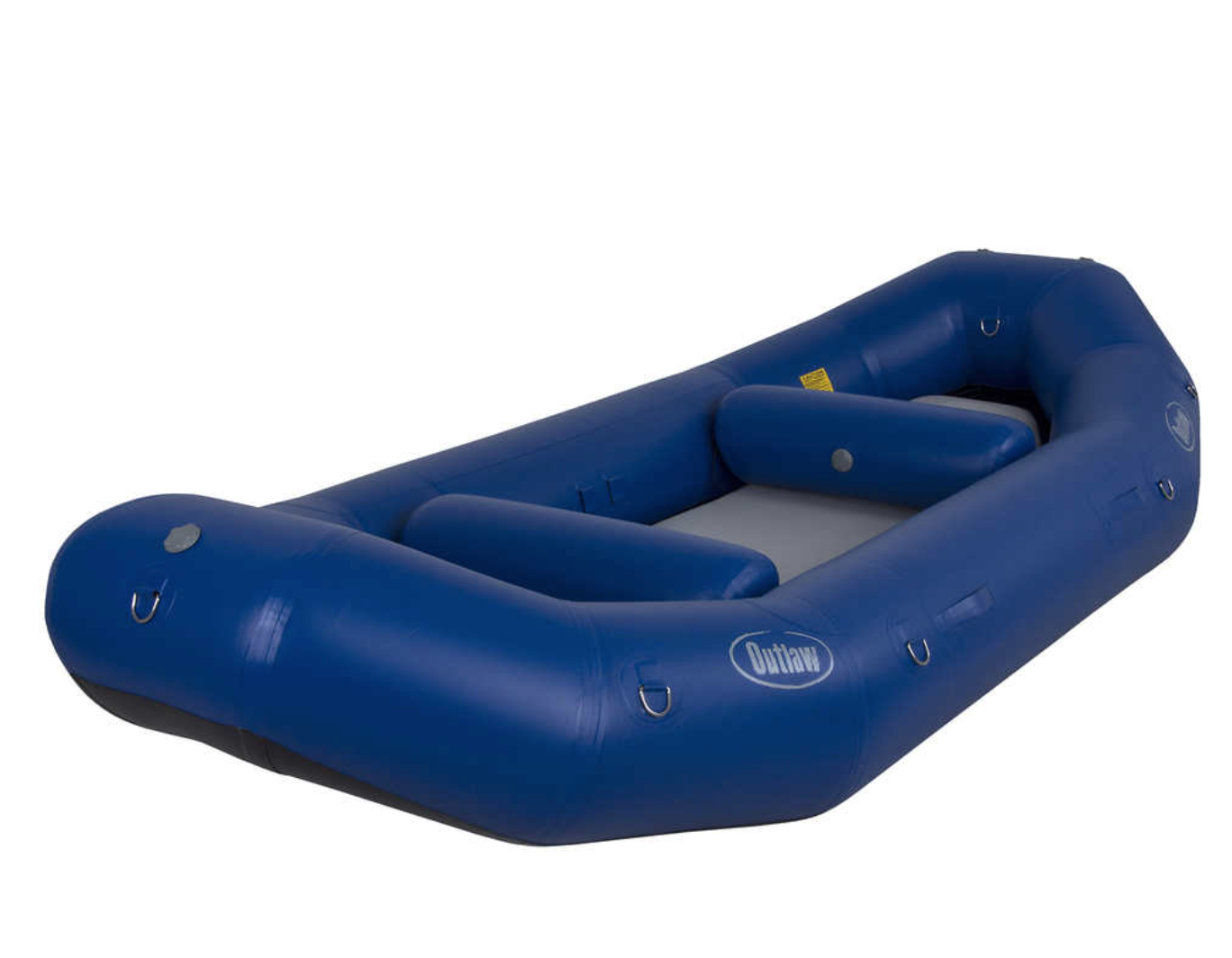
The NRS Outlaw 130. Source: https://www.nrs.com/product/86038.01/nrs-outlaw-130-self-bailing-rafts
Best thing about it: Inexpensive
Worst thing about it: Runs like S*&# in technical whitewater
Aire Tributary 13.0
Intriguingly priced around the same as the Outlaw 130, this boat got heavy use during our drought stricken 2015 season, and held it’s own fairly well. Lead guides on the Skykomish River did not report back any serious complaints, and as this raft was utilized alongside a very popular raft in Washington, the Aire 130R, it was reportedly nimble enough to keep up and handle the steep technical drops of Boulder Drop on the Skykomish. The Tributary 13’s most detrimental features were that the material used on the exterior skin was not the same PVC used on the other Aire designs (Ferrari PVC), and for some reason in the heat the rafts tended to stick to other boats like glue, almost comically. The rafts were slightly softer and less rigid than that of the standard Aire rafts, causing them to flex more and in steep drops like the ledge over “the fence” on Boulder Drop the nose tended to bend back and “squeeze” our guests. The raft has diminishing tubes and as a rule it was not used with a stern mount frame. The material was plenty durable; not as tough as the NRS Outlaw material, per se, but also notable is that the Aire Tributary designs also feature an internal urethane bladder (noticeably absent on the NRS rafts). One critical difference between the Tributary models and the standard Aire raft designs (E, D, R) are that the Tributary ballast floor carries more water than the others, and thus when you pull it out of the water it sags tremendously; this was the chief complaint about this raft.

The Aire Tributary 13.0 Raft. Source: http://www.aire.com/tributary-raft/tributary-thirteen-hd.asp
Best thing about it: Best all around budget raft
Worst thing about it: loading it in and out of the river and waiting for the eternal spring of river water to drain out of it… also; they’re ugly (according to our guide Brandon Steele, it’s “fugly”, which apparently is even worse than ugly).
Aire 130R
I know that there are a few guides from other whitewater river outfitters in Washington state that will be up in arms that we put this raft so low on the list, but let’s get into the details here. Bottom line is that this raft is one of the most stable boats in the 13 foot class, and has the rigidity to handle big drops. The problem with it is that it carries too much momentum, and has a feeling of a 15 foot with a hole in the floor. I mean, this sucker is a pig. In fact, the guides nicknamed it Miss Piggy and it carried that name for years. The reason we bought one in the first place was that it was the raft used by a competitor, and thus used by the guide that came to us from that company. At the end of the day this raft had the incredible durability that can be expected from an Aire raft, coupled with the stability expected from a wide design, with fairly large tube diameter. It’s only issue was that it was slow, hard to turn, and with 6 people in it became the river rafting equivalent of a greyhound bus with no power steering.

The Aire 130R Whitewater Raft. Source: http://www.aire.com/aire-raft/130r.asp
Best thing about it: Tough as nails and stable as a rhino
Worst thing about it: Has no ability to change it’s mind mid rapid, making it a liability in technical whitewater (which we have a plethora of in Washington)
Aire 130D
This is a common raft used in Washington by several outfitters on the Wenatchee and White Salmon Rivers. It’s a design that occupies a middle ground for Aire between the Super Puma (A narrow, 13 foot long raft with diminishing tubes) and the bludgeoning 130R. The 130D is sleek, and does not handle a 6 load with anywhere near the capability of the R series (a notably bigger raft in every way), and does not handle the tight spaces like a Super Puma, but it does everything well. Additionally, if you can run a 130D with a 6 load (that is, with 5 paddlers and 1 guide, or an “R6) you have a sweet little technical rapid runner. The 130D is a raft that we hesitated to give up, but ultimately did so in favor of having multiple raft designs in the 13 foot arena. It’s a raft that if we would have stayed small as a company would have worked well as an all around raft for all river levels on the Sauk and Nooksack Rivers, where it seemed to be very at home. Notably, the crew of Triad River Tours did like this raft and it ended up on the river a lot, and there was one commercial trip where the river swelled just before getting started and it handled the big water surprisingly well, making it a much better choice than a Super Puma for big whitewater.

The Aire 130D Whitewater Raft. Source: http://www.aire.com/aire-raft/130d.asp
Best thing about it: Good at everything
Worst thing about it: Excelled at things more relevant to the private rafter market
Maravia Spider
Another raft that probably deserves to be higher on the list, at least in the minds of those who love this design. Similar to the Aire Super Puma, the Spider is a narrow raft designed to run tight chutes and technical water. The Spider has the designation of having incredibly large (20.5” diameter) tubes on such a narrow boat, which is cause of it’s demise in our fleet and perhaps the reason why the raft design was redesigned by Maravia in recent years (now called the “Wider Spider”). The Spider effectively tumbles because the large tubes create a higher center of gravity; it is thus a great raft to be used to agile and/or experienced paddlers, but as a commercial raft is more suited for less technical water like that of the Wenatchee River, where there are large recovery pools to deal with the carnage that is invariably a part of running a commercial operation with Spiders. Still, it’s important to note that many great guiding companies use the Spider as their primary raft in low water on some pretty difficult whitewater. Wild and Scenic River Tours on the Nooksack can be seen running Spiders nearly all year, and on the Lochsa, both Mammoth and Three Rivers use Spiders effectively; naturally, though, these companies tend to use experienced guides who can compensate for the rafts tendency to flip with a little fine tuning in their paddle strokes and commands. The Spider handles 6 loads very well in water like the Wenatchee, making it a popular raft there. The Spider is unique in it’s narrowness and thick tubes, and has a specific niche. One of the key reasons why we preferred the Aire Super Puma to the Spider was that the Spider controls itself in a way that almost requires the guides to retrain themselves. It’s a unique boat that does not do well when turned sideways (which is something that rookie guides seem to love doing); let’s just leave it at that.

The Maravia Spider Whitewater Raft. Source: http://www.maravia.com/index.php/main/product_detail/154/7
Best thing about it: Money maker for 6 loads on less technical water
Worst thing about it: Flips like your moms pancakes when she’s drank far too much coffee and has a new spatula.
Aire 130E
This raft was one we picked up from an old University of Idaho rental fleet, and ran for a summer as an experiment. The boat is highly specific, but deserves some attention, if for no other reason than being the primary choice of Dan McCain and others who have taken to running them down very serious Class 5 water in an R2 setup. The “Eliptical” design of Aire is eccentric and makes no sense at first, but if you get to running the thing there are a few interesting tendencies that these boats have. The first is that the nose pierces waves and looks and feels cool; like you’re in the Trojan war and are stabbing waves like Achilles stabbed Trojans (bad analogy but hey, experience it and you’ll see). The other is that when you run steep drops the back end of the raft is so square that it has a tendency to send you down river in a straight line after running pour-overs. Don’t believe me, look at the design and do the math; rafts that are round on the back have more of a tendency to get turned sideways after boofing off of a hole. The E series is also a nice medium between the R (round) and D (diminishing) tube designs of their other rafts in that it isn’t as sluggish as the R series and is more stable than the D series. Putting a stern mount on a 130E is…. Interesting, to say the least. You feel like you have a guided missile system; the issue is that with this configuration you are really limited to a 4 pack, but if you do run this system we recommend you do so with 8’ oars and a competent paddle crew, and you’ll find you have a raft that’s capable of running about as gnarly of whitewater as possible in a raft.

The Aire 130E Whitewater Raft. Source: http://www.aire.com/aire-raft/130e.asp
Best thing about it: Fun 13’ raft in continuous steep drop whitewater
Worst thing about it: Has almost no viability as a commercial raft due to internal dimensions.
NRS E-132
This popular raft was voted by Backpacker magazine as “Gear of the Year” in 2016. It’s easy to see why it’s popular with private boaters; the diminishing tubes and width make it fun and splashy while being capable as a centermount as well as being a solid paddleboat. It doesn’t struggle at all carrying significant weight for it’s size, and one of our guides specifically recalls when it rescued an additional 6 guests (for a total of 12 people) and ran a class 3 rapid with probably over a literal ton of human flesh on the Sauk River. Yes, this raft is a low water gem, especially in warmer climates. Which leads us to it’s major problem; hypothermia. In Washington our water is cold, and hypothermia is our greatest risk to human life, and as a result we want our rafts to have either round tubes or at least plenty of rocker/kick on the bow to prevent our guests from getting splashed continuously and getting cold. This was, ultimately, the only issue with this boat. Also, you do not even want to try and put a stern mount on this puppy; you’ll look like someone driving down an old logging road in a 4 wheel drive pickup that has been lowered 4 inches; anyway just don’t try it… we did it for you… trust us; there’s no need to go there.

The NRS E-136 Whitewater Raft. Source: https://www.nrs.com/product/1081/nrs-e-132d-self-bailing-rafts
Best thing about it: Awesome fun family type raft in splashy (warm) class 3. Stable.
Worst thing about it: Cold
Sotar ST 13’ (custom design)
This raft was stretched out to 13’9 and had some other custom features to it, and so it’s really not relevant for someone looking to purchase a stock model raft. The Sotar material is fantastically light, and the rafts always run exactly as you would predict them to. The new material makes a squeaky noise reminiscent of bozo the clown at your nieces 6th birthday party when some kid asks him to make a bicycle; it sounds like a bunch of mice mating in the bottom of your raft. That may be exciting or detrimental to your quality of ride through the rapids; we don’t know but figured we should point it out. Sotar rafts are light; did we say that? Light as a freaking feather; this is awesome. They are light and durable, and Sotar is a smaller company that manufactures rafts by hand and has a reputation for excellent warranty service. They get full props from us for being Johnny on the spot with custom designs, and being just in general a great group of people to work with. There is a reason why their rafts are often called the “Ferrari for the private boater”. Their raft material is a simple urethane material that is notably tougher than PVC or Hypalon, and is welded together by hand. Their rafts are more expensive, but for some they are worth it. The guides ultimately felt that the Sotar design ran very similarly to the NRS rafts, and that the added durability did not justify the cost in our operation. Nonetheless, if money is no object, and you want to have a private rapid running raft for the rest of your life; call Sotar and tell them we sent you. Ours was also printed in the colors of the American flag because we ordered it on 4th of July weekend, which is cute.

The Sotar ST 13 (uncustomized). Source: https://sotar.com/products/sotar-st-13-classic-raft
Best thing about it: Sexy in every way
Worst thing about it: Expensive in every way
NRS E-130A
You’re probably trying to find this design on the catalog and you can’t; that’s because we have the only one. While you cannot order this raft, it is worth noting here because the design itself is an excellent case study. The 130A (named such for it’s original intent which was the whitewater of Austria) is a weird looking creature that has no equal or similar craft in the industry. The tubes are 20.5, making it pretty thick and capable of carrying a lot of weight down the river. It’s 13 feet long, but only 5’11 wide, making it a narrow yet thick raft. It has the look of a very small gear boat, and it performs just as you would expect; it does very well with weight for a raft with such big tubes (it carries weight better than the flagship NRS E-130; a very popular raft). The only thing about it is that, as it’s a raft design similar to the Maravia Spider, it flips you quicker than you can say WALLACE. We have literally flipped this raft more than all of our other designs put together. Now, that’s not to say it doesn’t have a lot of successful trips down the river; it does, in fact. The only thing to be mindful with this design is that it’s more of a smooth riding Class 3 raft. If you put it in technical Class 4 water, or you get her turned sideways for even an instant and you’re upside down. The 130A is still a guide favorite, and a raft that we continue to use in an expedition capacity for protocol and training runs because it’s an excellent training boat that is highly responsive, and in the hands of an experienced paddling crew it can run some pretty amazing whitewater when it’s not weighed down. We enter this raft in this competition because it deserves to be here; even though it’s not a commercial production raft, it’s worth considering it’s value as a design because most 13’ rafts have 18-19 inch tubes and are 6’-6’6 in width. This design has larger tubes and is narrower than other raft designs that are for similar uses, and it does just fine, and in a lot of ways is superior. It also is a good raft in cold conditions because it tends to ride over waves and holes rather than spear into them.

The NRS E-130A whitewater raft (action photo included for added effect)
Best thing about it: Handles weight exceptionally well, and does very well in low technical water with 6 loads.
Worst thing about it: In big water it’s like a rodeo where they ride giraffes instead of bulls (i.e. it’s narrow and tall, and well… you’re probably already in the water by the time you had time to ponder this analogy).
Maravia New Wave 2
This raft is a sort of half way point between Maravias stellar Williwaw 1 and the often neglected and less popular Espirit design. The New Wave models have 3 chambers and only come in Blue. The (at the time) president of Maravia, told us that “all of our New Wave models are blue, except the one we sent you, which just so happens to be pink”. This strange raft, which apparently the color was later named “Watermelon” debuted in our system on a trip that was put on specifically for military personnel from Lewis-McChord Joint Base in Washington. We won’t bore you with background information about gender stereotypes and the color pink, but lets just say that the soldiers that occupied this raft during it’s first weekend ended up taking a picture of, giggling fully at the contrast between their camo clothing and the “watermelon” color of the raft. The New Wave 2 design is highly versatile and can fill multiple rolls; it is also one of the few 13’ rafts (it is actually 13’6) that does well with a stern mount. We used 8’6 oars on this model with great success on technical rapids with 6 guests per trip. The New Wave 2 did fine as a paddle boat, and was very comfortable. The 18.5 inch tube diameter is slightly too small; we would have preferred the tubes to be at least 19 inches. Other than that this is an excellent buy at it’s price point, and offers a very capable raft for a variety of uses.

The Maravia New Wave 2 whitewater raft. Source: http://www.maravia.com/index.php/main/product_detail/173/4
Best thing about it: Value, durability, and ours was pink.
Worst thing about it: Tubes are slightly too small to make it a dominant boat in bigger water.
Hyside Pro 13
This raft was a great addition to our fleet for a season, and it proved itself as a jack of trades as it excelled in high water Class 4-5 rafting on the Skykomish River, and also did well as a people mover in lower water when technical rapids were the daily norm. The Hyside design is commercial friendly, and perhaps a little to stout for most private boater use. The larger tube diameter and flatter nose make it a tough looking raft with excellent carrying capacity and good stability in steep drops. There really isn’t much else to say other than this raft was one of the most useful raft designs we have ever had, and was a raft that seemed to do well wherever we put it. It was simply the runner up in our competition to the similar NRS E-136. We may have ultimately went with the E-136 simply for the convenience of ordering our rafts from the same supplier that we get our guest and rescue equipment from.

Photo of Hyside Pro 13.0 source here: https://hyside.com/product/pro-13-0/
Best thing about it: Good at everything
Worst thing about it: Manufactured overseas (?)
NRS E-130 (and Otter 130)
This raft is, for us, not a commercial raft, even though it’s commonly used as one. It is, rather, a raft that can simply do more than any other in the comparison. It’s major weakness perhaps is that it’s more of a class 3 technical water raft than a big water raft due to it’s smaller tubes and splashy factor. The Otter 130 is perhaps the greatest private boater raft on the market when you consider what it can do. It can carry a family of 4 down the river with a centermount frame and gear, it can run a paddle crew of 6 plus guide with relative ease, it’s light (in the Otter design especially), durable, comes with a good warranty, and just in general represents an incredible value for a raft that is at home in a variety of situations. It’s similar in designed purpose to the Hyside 13.0 but differs in that it’s more of a “playboat” and fits in better with lighter loads and smaller rivers. NRS made a point to design a variety of 13 foot rafts, and the E-136 takes the pressure off of this design in terms of the “big water” raft. The E-136 is more akin to the Hyside design, while this is more like the Aire 130D. It is sleek, fast, useable, and in the words of one of our trip leaders on the Skykomish; “it just gets the job done”.

The NRS Otter 130 Whitewater Raft. Source: https://www.nrs.com/product/1136/nrs-otter-130-self-bailing-rafts
Best thing about it: Fun
Worst thing about it: Not a great design for big or steep water (especially when under load)
Aire Super Puma
The Super Puma is a raft design that lives in the hearts of many guides and private rafters. It’s phenomenal handling and technical water sure footedness and predictability is unmatched. Furthermore, there will never be another raft of this design that surpasses it’s abilities in the type of water it was designed for (see the Hyside Max 12.0 or the Star Wonder Bug). The Aire Super Puma was recommended to us by a local kayaker who worked on the Upper Yough in Maryland, with a river similar to ours in some ways and a system similiar; technical, steep drops, quick turns, well compensated guides, simple system. The design of the Super Puma can really only be done by Aire as it has the continuous rocker of the sewn outer skin. The new Maravia collaboration with Stream Tech is similar in that the rafts have high rocker and continuous curve on the bottom; but make no mistake the Super Puma was doing this same work on commercial trips for decades before this design (which is a great one for its intended purpose) was conceived. The Super Puma is not well suited for heavy loads, which make it a cumbersome boat to paddle with 6 people (about how many you need in a commercial operation to turn a profit). Instead it occupies a niche in a raft fleet for a commercial operation in it’s ability to take 3-5 guests comfortably down lower water on technical rivers. The ballast floor of the Aire Super Puma is so much narrower that it’s not overly heavy like that of the 130R or 130D, and while it is flippy in ways similar to the Maravia Spider, it’s lower to the water, with 18.5” tubes, and if pointed in the right angles can break through much larger waves/holes than you would imagine. The Super Puma was described by one of our guides as the Kalashnikov of rafts; meaning that it’s simple to utilize and does it’s job in whatever conditions are required of it. Overall it’s a fantastic raft for the coastal whitewater of our Washington rivers, and is an excellent choice for the private boater; offering a great warranty and a raft at a lower price point than almost all of it’s competitors of similar quality and design.

Aire Super Puma Whitewater Raft. Source: http://www.aire.com/aire-raft/super-puma.asp
Best thing about it: Like driving a Porche on a back road in the Alps. R2s very well.
Worst thing about it: Better suited for guides with experience and has inherently lower carrying capacity due to lack of width (you wanted a Porshe not an Econoline Van).
NRS E-136
Our favorite raft in the 13 foot class for all around commercial use on the whitewater rivers of Western Washington is the NRS E-136. The raft does not have the low water abilities of the Super Puma or even it’s smaller sibling, the E-130. It does not have the stability of the Aire 130R, nor does it have the narrow slot dropping ability of the Maravia Spider or NRS 130A. It is not a raft made with the space age urethane of the Sotar, or uretane encapsulated PVC like a Maravia. It’s made of simple Pennell Orca (Rubber, for the uninitiated), and it will puncture, and will flex. The E-136, quite simply, has almost no weakness, and for that reason it tends to own other rafts because no matter what you do, if you run whitewater rafting trips long enough, the weakness of your system will be exposed. This is simply a raft that has stood the test of time for us and has never failed in any situation. The 20” tubes are large for a 13’ boat (it’s actual length is 13’6), and it has a high rocker which make it exceptionally well suited for steep drops. While there is a common perception that NRS rafts are not rigid enough to drop waterfalls, if it’s pumped up enough it handles the steep “fence” drop through the needle on Boulder Drop just fine, and could be made tight enough to run Husum Falls on the White Salmon so long as a frame wasn’t involved and the tubes were pumped up intentionally tight. The E-136 does OK with a stern frame and 6 guests, but does exceptionally well on larger coastal rivers and a paddle crew. The high bow and stern kick would create issues in the wind for multi-day rafting, and it can be hard to see over the bow of the raft at times. The exaggerated lines of the 136 are intentional as the raft was reportedly (we point to Ian at NRS for this information) designed as a Lochsa river raft; meaning Class 4 rapids with steep drops in continuous whitewater conditions. The 136 can be rolled easily, patched if punctured, and comes with a moderate yet reasonable price tag. It also comes in red, and we like red.

The NRS E-136 whitewater raft. Source: https://www.nrs.com/product/1076/nrs-e-136-self-bailing-rafts
Best thing about it: Can handle any whitewater you throw at it.
Worst thing about it: Is like a sail pointed in the wrong direction in the wind.
Read more:

River Rescue Throw Bags, Ropes, and Static Lines
A look at whitewater river rafting and kayaking rescue throw bags.
River Rescue Throw Bag Investigation
There is perhaps no more basic a rescue tool in whitewater river rafting and kayaking than rescue rope, typically stuffed into a bag, and then stuffed into the corner or a raft or inside someone’s kayak. On the river, rope can accomplish more than any other rescue tool, and can extend the rescue radius of any river rescue by double or triple, at least. Almost as important as having a rescue throw bag is having one with enough tensile strength that it can handle all of the tasks required of it during any foreseeable rescue, while not being too difficult (i.e. too heavy) to throw. We’ll start with the basic 75 foot rescue throw bag, which is manufactured by every whitewater rafting equipment supplier, most commonly used in the USA on commercial rafting trips are the bags by Northwest River Supply.
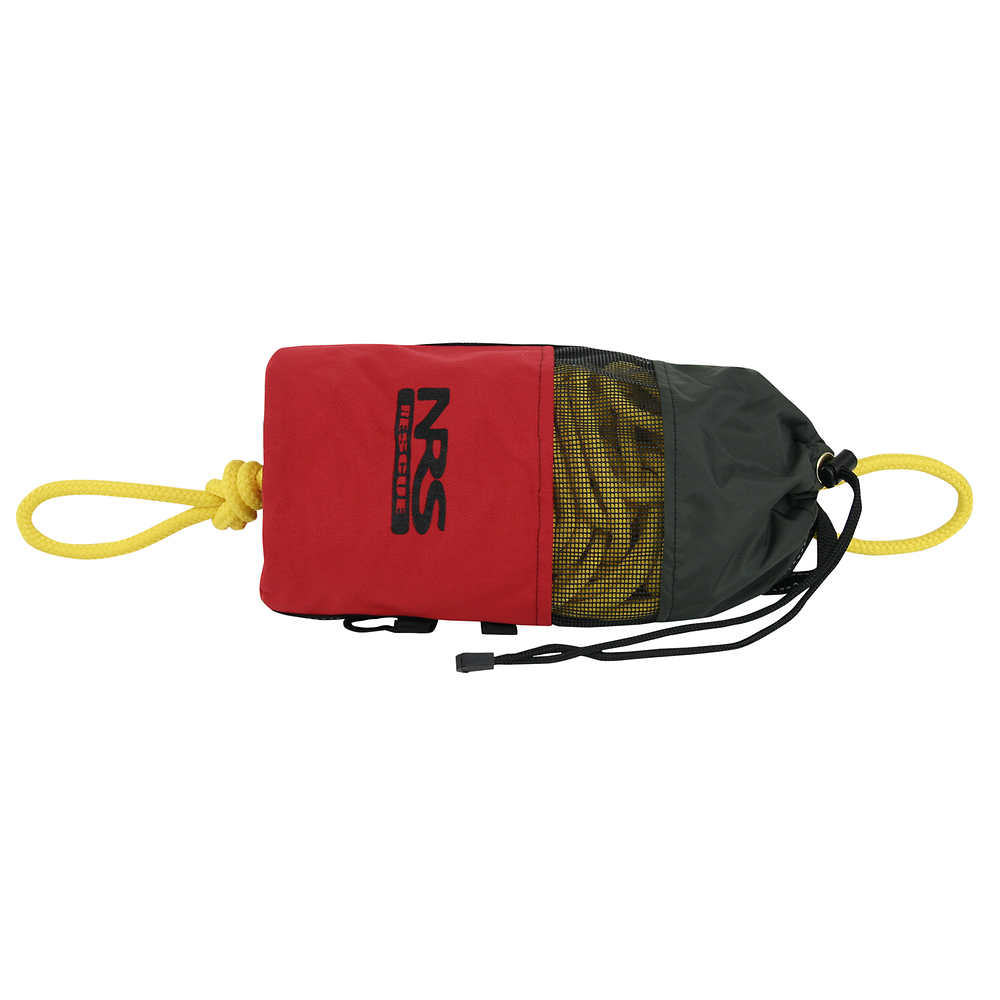
A standard NRS Rescue Throw Bag with 75 feet of rope and a tensile strength of 1900 pounds.
The NRS Standard Rescue Throw bag has 75 feet of 3/8” polypropylene rope rope with a 1900 pound tensile strength, stuffed into a bag with a piece of foam in the bottom of it to ensure it doesn’t sink. This is the industry standard, and by all means the yardstick that we’ll analyze all of the throw bags here.
This bag is fairly easy to throw both overhand and underhand, and many professional guides and seasoned boaters have perfected the art of throwing the bag to the point where they can throw it to the very end of the rope; meaning that every time they can throw 75 feet. This is pretty impressive to watch from dry land, and if someone can toss a throw bag from a moving raft that is tumbling down a whitewater river, and do so with accuracy, in an actual rescue scenario, and actually hit (or come close to hitting) the whitewater swimmer with the rope, they deserve to get some kind of prize or have a blog written about them. (or at the very least get a raise from their outfitter).
The problem with this rescue rope is that it’s 1900 pound tensile strength limits what it can do in more serious swiftwater rescues. A raft full of people/guests/paddlers (lets go with 8 people plus guide), a first aid kit, pin kit, and some other necessities, is itself going to weigh upwards of 2000 lbs. So the rope itself isn’t as strong as the raft and cargo is heavy; this is going to create problems and a potentially dangerous situation if you pin the raft with everyone in it. At our swiftwater rescue trainings done by the Swiftwater Safety Institute, the instructors are constantly preaching not to overwork your gear, and if you do not have the proper equipment to put the rescue system together, don’t even try it, and rather wait until the right equipment can get to you, or otherwise recognize that you’ve got an imminent failed rescue on your hands. The bottom line is that 1900 pound strength rope, which is standard in these rescue throw bags, is great for pulling people to the raft, but if you want to do a z-drag, or serious “boy scout pull” to get a pinned raft off of a rock, you simply cannot do it without maxing out the strength of the rope. Which brings us to the savior; Dyneema, or what is often called “Spectra” rope.
At over twice the price, and twice the load carrying capacity of the standard rescue throw bag, bags with “Spectra core” rope technology are the industry standard when it comes to rescues that involve mechanical advantage and/or real life saving reliability in difficult situations. The NRS Pro Rescue Throw bag is filled with the standard 75 feet of 3/8 inch Spectra core Dyneema rope, and comes with a tensile strength of over 5000 pounds. This conjures up memories of the old tv show “Home Improvement” and the iconic grunting of Tim “the toolman” Taylor who always seemed to find a tool with too much power for the job. Well, the reality is that if you have a rescue that requires a rescue rope with more than 5000 pounds of strength; needless to say, you’ve really screwed up, and no matter how things end up your name and likely pictures of your raft (or what used to be your raft) will begin circling Facebook and you’ll probably have someone write a blog about your misadventure. The point is that 5000 lbs. of strength is enough to handle almost any typical whitewater river rafting misadventure that often befalls the commercial raft trip outfitter. Furthermore, if you’re going to be tied in to your rescue PFD in a real life “live bait” or “strong swimmer” whitewater rescue, there is a certain peace of mind being tied in with a rope strong enough to lift your Toyota Corolla off the ground.

The advantageous NRS "Pro" Rescue Throw Bag, with 75 feet of Spectra core rope and a tensile strength of over 5000 pounds.
The problem with using Dyneema rope for your every day rescue throw bag is that they’re a little heavy and the rope is a little stiff; this makes rescues slightly cumbersome and for less muscle bound rafting guides that perhaps didn’t play shortstop in college, the distance of their rescue throw in a real life situation (think middle of the river in a raft that is rocking back and forth, with 2 or 3 people screaming, with cold fingers and a swimmer who is looking at the wrong side of the river for their rescue) to approximately 30 feet. In actual practice it may be beneficial to carry a smaller rescue throw bag with lighter rope, and next to it, or perhaps even better yet, inside a handy dry bag, would be your heavy duty rescue bag.
Of note are the “compact” NRS rescue throw bags. The standard bag has 70 feet of ¼ inch polypropylene rope with approximately 900 pounds of tensile strength, and the “Pro” type, with 70 feet of rope and a 2500 pound limit. Note: You may be thinking what we’re thinking, and you’re right, we were thinking it… that 2500 pound tensile strength packed into a tight little throw bag can be a pretty useful river rescue tool for smaller rafts, for kayakers, and for most rescue scenarios, and the bag is easy to throw in chaos. You’d be right, and 2500 lbs. of strength is a pretty handy rope to have at the ready, the only issue there (aside from the inability to do heavy duty rescues) is that the rope is thin and thus hard to hold on to, and the other fairly damming issue with the smaller rope diameter is that it doesn’t work well with a prussic. In order to get a prussic chord small enough to bite down on rope that small you’d be looking at 4mm, and then you’ve got a serious weakness in your system due to the smaller prussic. Nonetheless, these smaller bags are uber-useful due to their lightness and throwability from inside a raft, or otherwise in a situation where you don’t have the ability to get a really solid, Tom Brady-esque throw bag release (Joe Montana, Dan Marino, etc.). It’s a pretty solid plan to have a smaller bag in your raft within easy reach of the guide or the other paddlers, and then have a second, more serious rescue throw bag filled with spectra core rope for bigger rescues.
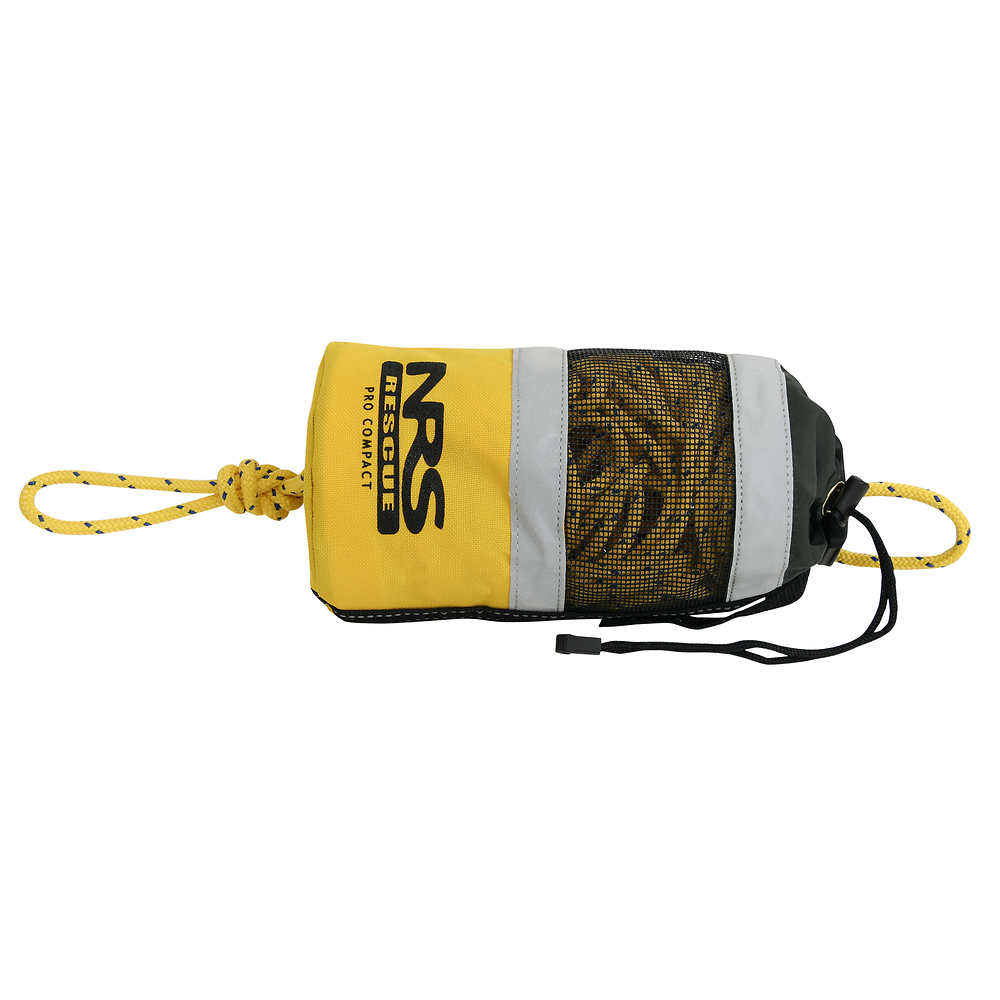
A Compact Pro Rescue Throw bag, with 70 feet of 1/4 inch Spectra core rope, and a tensile strength of 2500 pounds. A rope with more strength than a standard throw bag, but in a more compact bag.
Static ropes are a different animal altogether. This is a hotly debated topic, but one we’ll study in brief here. The idea here is that if you’re rafting on a whitewater river with any width to it (i.e. not a creek), then you’re really not going to be able to span the width of the river with only one 75 foot throw bag. When you think about the distance of 75 feet while sitting at your kitchen table, it seems like a long ways, but once you try and span the width of a rushing river, and then add to that a tie off, a z-drag, or whatever else is required of your rescue, the reality is that you’re going to run out of rope, and when you do you’re stuck between a rock (perhaps literally) and a proverbial hard place. That’s why it’s handy to carry multiple throw bags or a static line.
Unlike tying two rescue throw bags together to create your haul line, using a static rope (usually 150-300 feet of 3/8” rope specifically designed for rescues) eliminates having to “jump” the knots in your system, and gives you a really awesome foundation to perform some really great river rescue systems. With a well trained, confident rafting or kayaking crew, and a basic pin kit, coupled with a static rescue rope, you’re probably in good shape in just about any rescue. In this way, any river rescue that is serious, performed without the advantage of a static line, is going to be cumbersome. Using throw bags tied together to get the appropriate distance is just going to gum up the system. So, it may be advisable to carry a static line in your pin kit, or what most outfitters we’ve been around call, a “sweep kit”.
So in the sweep kits at Triad River Tours, which are increasingly elaborate as well as continuously debated amongst our professionally trained guide staff consisting of swiftwater rescue professionals, we have several large carabiners, prussic, tubular webbing, a bunch of other rescue goodies like a rigging plate, a waterproof notebook, et. al, and at the base of the drybag housing the kit is a full 300 feet of rescue rope. This gives us the ability to perform any rescue we may encounter under most circumstances. Later in the season, or on trips where our scenarios would be predictably more simple, we may keep this rope in our bus, or back at camp, and move to a system involving several throw bags. Because we always keep one small and one large spectra core throw bag on our trips, and because we will always have at least two crafts on any rafting trip, we will be able to rig together two throw bags for a total of a 150 foot improvised static line. Having only one throw bag on each raft presents several difficulties, and common sense will tell you that if you are to only carry one throw bag per raft, then you’ll really want to consider carrying a static line in one of the rafts (more often the raft in the rear of the pack). Keeping in mind that if you do not have access to this raft in a rescue, you will not be able to use the static rescue rope contained within it (so don’t put your least experienced guide in the sweep boat). Additionally, consider that if you are running a whitewater rafting trip with 3 rafts (a very common number from what we’ve seen on the rivers we’ve run), and each raft has 2 throw bags, and each guide has a small personal sweep kit (carabiners, prussic, webbing) then you probably have enough gear between the three of you to perform the necessary rescues you may encounter. Also keep in mind that weight is your enemy when it comes to rafting rescues; the more equipment you carry adds to peace of mind but comes at the cost of both convenience and maneuverability; and when some old school rafter tells you that it doesn’t matter how heavy the raft is, just spend a few minutes perusing Youtube under the search term “raft pin” and find a large raft full of gear, stuck on a rock in the middle of the river, and see how long it takes to get the thing unstuck. The point here is to use common sense and try and consider a multitude of factors. In a real river rescue, things happen fast, so preparation and being familiar with your system, and being ready to adapt and improvise your river rescue gear will be paramount to your success.
In the video below, one of the Triad guides does a simple simulation of a whitewater river rafting rescue involving a rescue throw bag retrieval.
Until next time friends, keep the bow pointed downstream, and enjoy your time on the river!
Read more:

What is the correct rafting paddle length?
Investigating the proper rafting paddle length and the trend towards the shorter paddle.
Whitewater River Rafting Paddle Length
Our guests will probably be surprised to know just how well thought out some of our equipment choices are, and one that is of constant analysis is that of paddle length. At Triad River Tours we use almost exclusively paddles of 57 inch length. This number may be meaningful to you if you’re a seasoned paddler, and it may mean nothing to a novice, but it means a whole lot to us, and here’s why:
Rafts that are used for commercial whitewater trips have a tube diameter of between 19 and 22 inches. You might be thinking that’s not a very big difference, but when you’re on the river in a raft with 19 inch tubes it’s a totally different experience than one with 21 or 22 inch tubes.

Paddle length depends greatly on many factors of whitewater rafting.
There are certainly rafts designed to carry larger amounts of gear or people down the river, but for most purposes, in North and South America, if you go whitewater rafting on a commercial trip, your raft is going to have tubes about that size. Now comes the fun part of risk analysis with these seemingly arbitrary numbers.
With a smaller tube, people sit closer to the water, which means that when they go to dig their paddle into the river to propel it either forward or backward, the shaft and “t-grip” of the paddle are higher out of the water. When the t-grip (which is source of more whitewater rafting injuries than any other single factor) is higher out of the water and more exposed, it becomes more likely to injure someone by striking them in the face or otherwise uncomfortably bludgeoning them in some fashion while they’re on their whitewater trip. This is no fun, and everyone wants to avoid it. Thus begins the industries migration to the shorter paddle.
The 60 inch rafting paddle was the industry standard for decades. If a commercial rafting outfitter went to develop a stable of hundreds of paddles, there really wasn’t much doubt that the 60 incher was the proverbial swiss army knife of whitewater paddles. As time goes on, and outfitters are more concerned with liability, the paddles have gotten shorter. As a result there has been a reduction in t-grip incidents to a small degree, and outfitters can rest easy that they have done something to prevent this infamous whitewater injury… .but wait, there’s more.
There are three consequences that arise from using shorter paddles. The first one is that people running trips on rafts with larger diameter tubes are now farther from the river, which leaves them with two options; either they take strokes with their paddle blades not entire submerged (which effectively splashes the person behnd them with water as well as ultimately making the raft maneuver slower) –or- the paddler can reach down farther, changing their natural paddle position and hunching closer to the river. Reaching farther into the water does have the benefit of keeping the center of gravity lower to the river which aids in stability, but it also has the detrimental effect of making rafting guests, in some cases, more likely to fall out.
The second consequence of these shorter paddles is that our rescue radius is slightly shorter. The term rescue radius in this case, is meant to represent the distance you can snag someone from a whitewater swim in case of a flip or other out of raft experience. Longer paddles can be reached out to assist in the rescues of people from further away; a detail, to be sure, but in many cases an applicable one.
The third consequence of shorter paddles is that taller people are simply not built to use a short paddle. If you’re 6’4 and you’re running whitewater with a short paddle, well, you just look like the rafting version of a ¾ ton pickup with 14” tires. If that analogy doesn’t work just think of someone playing for the Yankees coming up to home plate and they’ve got a youth size baseball bat. The point here is that it just looks funny and in actual practice it’s downright awkward. Nonetheless, outfitters generally do not have (and would be ill advised to carry) multiple sizes of paddles to fit each individual person. The already complicated safety talk has swollen to almost a half an hour, and adding a 10 minute “find your correct paddle size” session would just complicate matters worse, and create less value for guests and prolong exposure to cold weather in many cases. Raft trip outfitters are between a rock and a hard place on this one, and ultimately the shorter paddle, with it’s undeniable utility of preventing broken noses and broken teeth on raft trips, tends to win out.
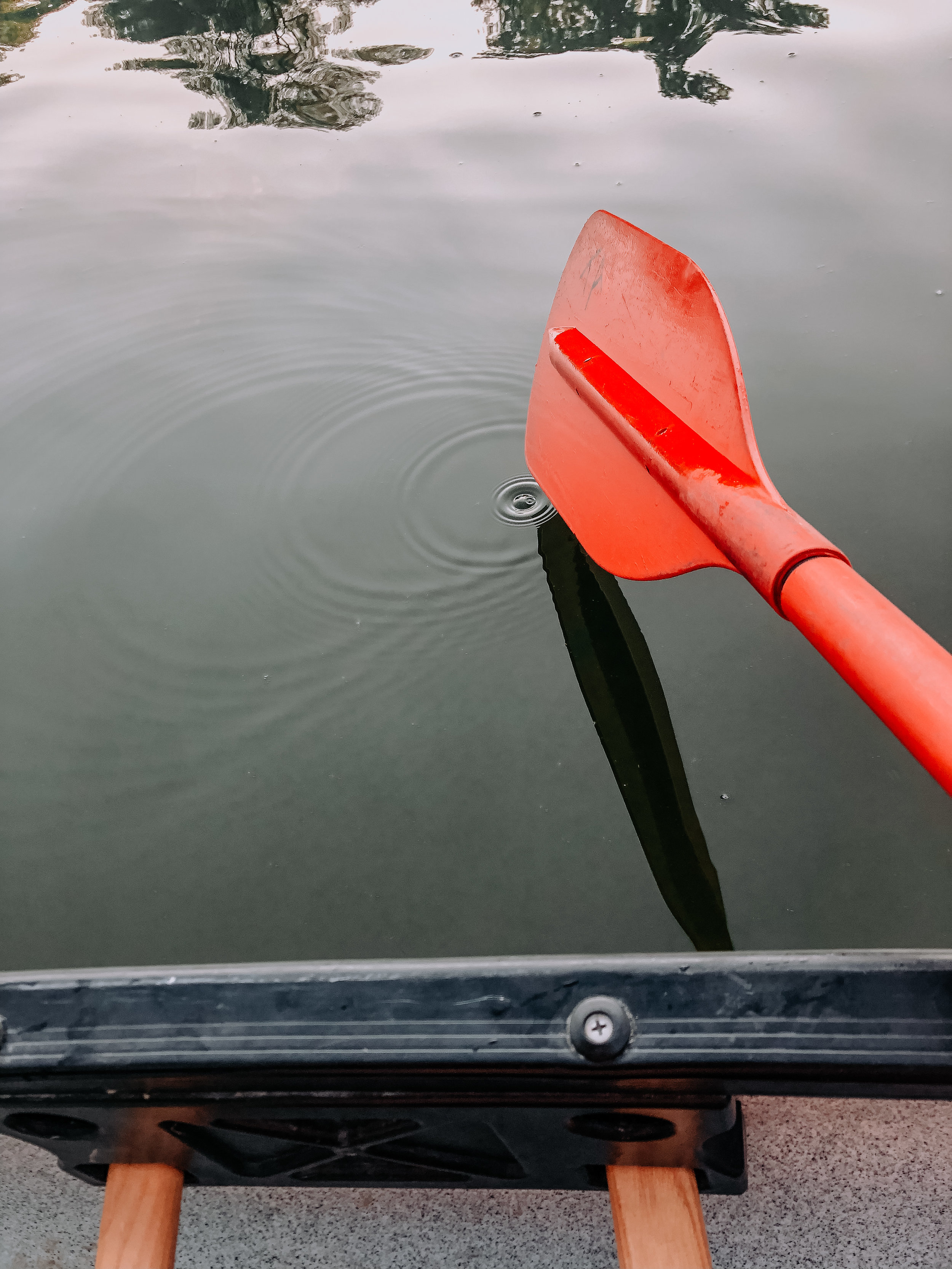
All commercial whitewater rafting guests are given a short paddle to prevent injury, and are then trained to use that paddle as effectively as possible during the safety talk.
Professional Whitewater Rafting Guides do not use the same paddles as their guests, for a number of reasons. The first is that they typically sit farther towards the stern of the raft, where they can get good purchase on the river with their paddle blade in order to turn the raft effectively. The rear parts of the raft are often up out of the water, and as a result a raft with 20 inch tubes effectively has 22 to 24 inch tubes for the guide because of the rafts natural rocker, or “kick” as it’s often called (think of snow skis or a sled; rafts have the same idea and are upswept in the front and rear). Guide paddles or “guide sticks” are whitewater paddles that are often 62-66 inches in length. Guides have deep and bewildering philosophies as to why they use a certain paddle length, from the PhD like explanation from some guides, to the simple “I found this one on the banks of the Gauley” explanation for our more economically challenged brethren.
At the end of the day Triad River Tours sticks with the philosophy that many outfitting companies do, and that is that all commercial whitewater rafting guests are given a short paddle to prevent injury, and are then trained to use that paddle as effectively as possible during the safety talk. Guides are encouraged to own their own personal paddle (it is, after all, a rite of passage to have your own guide gear), but supply guides with “medium” sized paddles in case they don’t have one or if theirs breaks on a trip. At Triad our guide paddles are 63” long.
So if you’re a private boater putting together your system, we recommend that you go with 57 inch paddles for a raft with smaller diameter tubes (anything 20 inches and smaller) if you want to avoid injury. However, if you have more experienced whitewater paddlers coming on trips with you, then it’s a no brainer to use the longer 60 inch paddle when you have people that are mindful of their t-grips. Less experienced paddlers tend to panic in the midst of whitewater and start flailing their paddles around, while more experienced paddlers will stay put and keep paddling, with their t-grips securely braced in their inside hand.
If you are looking to become a professional guide or looking to put together your personal rafting system and want to get yourself a guide paddle we recommend you look first at your height and length of arms, and if you’re a taller person (over 6 foot) go with a 64” or 65” paddle, and reserve the 66” paddles for the Amazons and Sasquatch like paddlers out there. If you’re shorter, say you’re between 5’ and 5’6 you’ll want a paddle of around 62”, keeping in mind that even if you are shorter you will need a paddle that can go deeper into the river. Most likely if you’re shorter you will not benefit much from going down to a 60” paddle.
Either way remember to cover that t-grip and always keep a spare paddle, no matter what length it is, because no matter how much you love your paddle, you will one day see it swimming down river without you, travelling with a momentum and tenacity for the current that you only which you could have had with your raft before it flipped over and sent your paddle on a private river rafting trip without you. Until next time, catch you on the flip side.
Read more: