
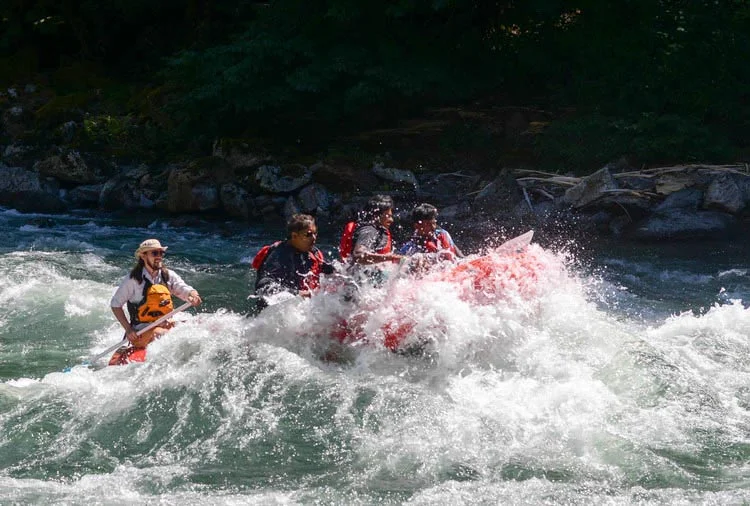
Whitewater River Rafting and Adventure Research blog at Triad River Tours. An inquiry into the state and nature of the river running industry and a guide to vacations and mountain adventures with professional guides.

Raft Construction
Considering the construction and design of whitewater rafts such as Aire, NRS, Maravia, and Sotar
For me, the type of raft, the make, the size, the tube diameter, and the age of the raft itself, is highly relevant to the trips we run. There have been many discussions through the years about how guests (i.e. clients, i.e. customers) simply do not know enough about whitewater to care about what raft they are in. I disagree. I think that definitely, people don’t have the same sort of scrutinizing eye that guides have, and they don’t spend their evenings kicking around the boatyard like the guides, arguing about whether or not a self bailing raft is a necessity for safety, or if Aire’s ballast floor really prevents “some” flips, or if diminishing tubes offer advantages as far as gear hauling; nonetheless I think it does matter and I think people notice.
There’s a few jokes I like to tell on occasion, and some of the readers have had the misfortune of hearing them (I am not funny)… my favorite joke I like to use when I start the safety talk at rivers edge for the upper Skagit is something like “welcome to the river everybody, we have experienced guides, prepared guests, and top notch life jackets helmets, and equipment, this is a great way to build a safe trip” (I pretty much always say that) “we have only the highest quality rafts for you today, we buy your rafts at K-Mart”… Everyone laughs, and maybe once in a while someone gets worried that we actually use K-Mart rafts, which is probably even more disturbing than me actually running a whitewater river in such a raft. The point is that it does matter where rafts come from. It does matter if they are capable of contributing to a safe trip. It’s my opinion that it matters, and even though I have guides that do not care which raft they run, day in and day out, we all recognize that some rafts have distinct characteristics, which help them excel in certain situations. Let’s talk about those situations.
Self-bailing vs. “bucket” rafts
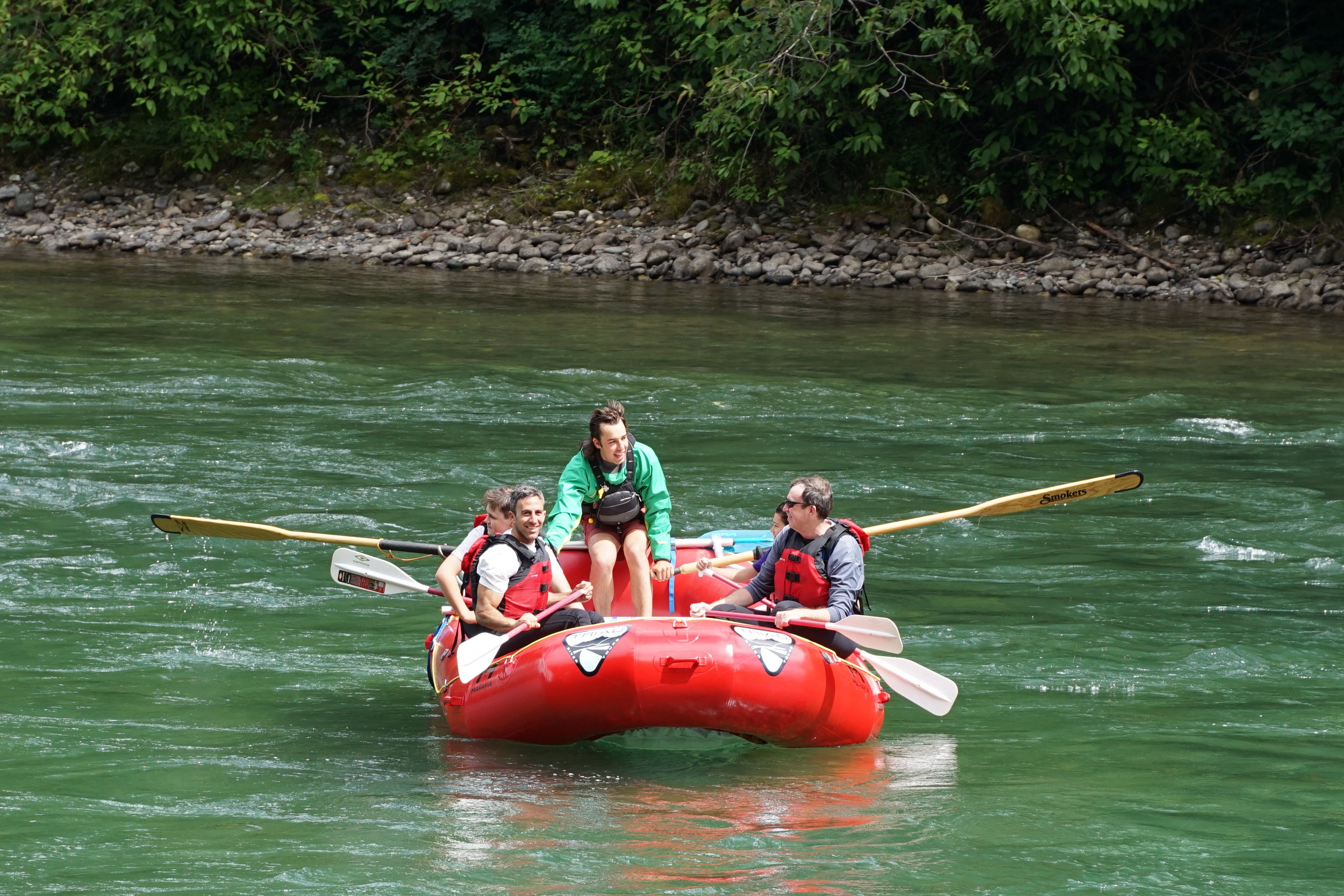
Triad River Tours uses self-bailing rafts on all of our rivers to ensure a safe and fun trip.
Let’s start with the bare basics. All modern day rafts used in commercial applications should be self-bailing. Long gone are the days when we supplied you with a bucket and a ½ gallon minute maid orange juice container, equipped with the side cut out, in order for you to bail all water that entered the side of the raft. Mind you, this is a lot of water if you’re whitewater rafting. I should know, when I started rafting in 1994, I used to bail water. At that time the company I was training with had their older model boats that were bucket boats (non self bailing), and then there was the new fleet, which were self-bailing. Sometimes you’d end up in a new one and sometimes an old one. I remember spending half the day bailing the raft out if it was one of those old bucket boats, and I wouldn’t wish that on anyone.
Along the same lines, we have to realize that the bottom of the raft is going to have a constant stream of water coming in and out because the floor is inflated, and has drain holes or seams on the sides and often times also in the front. Self-bailing boats give you incredible versatility, added safety (floors can be removed in case of a pinned raft) and make the experience more enjoyable because you can focus on scenery instead of looking down all the time and smashing your head into people’s knees. Furthermore bucket boats don’t maneuver well when full of water, it’s like rafting with an anchor tied to the bottom. Well, the long story short here is that modern whitewater rafts are almost exclusively self-bailing for a reason; they perform better. Make sure that your outfitter is equipped with self bailing rafts, and if not, I would love to hear the reasoning (other than simple cost effectiveness of keeping outdated equipment in use) for using such a craft in this advanced stage of watercraft.
Diminishing Tubed Rafts
This debate used to rage on 15-20 years ago, back when Riken was leading the pack and the Nez Perce was the model to have on multi-day rafting expeditions. Those days have long passed and the diminishing tube craze has settle down into more of an aspect of our sport. Diminishing tube boats offer smaller tube diameter in the front and (usually) rear of the raft. This gets the guests wetter, and also increased cargo space in the front and rear sections of the raft. Diminishing tube boats are also naturally better in the wind since they have less surface area going into it. There are multitudes of other arguments for and against which I will not go into because I am not someone that thinks the difference needs to be expressed complicatedly, but suffice to say that there are guides and private whitewater boaters out there who either love or hate diminishing tubes. I am indifferent and will use either, but in specific situations. Here are a few:
Diminishing tube boats are not our cup of tea on the Sauk River, and here’s why: We tried out several designs before choosing a raft on the Sauk River, a few models would be the Aire Puma, Super Puma, 130D (D stands for diminishing tube), 143D, the Maravia Diablo, and the Maravia Spider. All of these boats did very well, but for us they weren’t ideal particularly because we thought that in the worst-case scenario they kept people colder. Let me explain further; in early season the Sauk water temperature is usually in the high 30s, perfect for hypothermia exposure. The air temperature at this time of year is usually hovering in the 50-70 range, so collectively you have a pretty cold trip. While we think that getting splashed can really add some excitement to the trip, we didn’t think that it was helpful in terms of safety because a cold guest cannot function as well as a warm and comfortable one. Thus, we eventually decided to scrap the idea of running diminishing tube boats earlier in the season. We have had a lot of success in the warmer months with them, however, as the higher temperatures give people more enthusiasm to get a big splash of water to the face.
Raft Materials: Hypalon vs. PVC vs. Urethane
If there was ever an ongoing argument in the industry, it is the opinions about the best raft material and construction. It’s not as simple as saying that you are a fan of one raft material vs. the other, because in actuality each manufacturer cures, builds, or treats the base material differently, so there are fundamental differences in each manufacturer’s boats. But who makes the best boat?
When I was 13 years old I traveled around to trade shows and sold rafting trips with my dad. Every time people would ask us what kind of boats we used we would say, with pride; “Riken”. Well, at that time Riken was a great boat. They’ve since been bought by NRS and as far as I know are no longer in production. Still, Riken boats revolutionized the industry and many commercial rafting outfits still have old Rikens that sit in the corner of the shop rolled up and come out only once or twice per year when 500 sorority sisters or an entire Microsoft employee wing comes on a rafting trip. Point here is that Rikens were good boats, and they were made of Hypalon, which has dominated the industry for some time since. Hypalon, or rubber, is the base material (it’s often called something else, or I suppose Hypalon is a registered trademark, but it has become slang for all boats made of rubber). Rubber rafts like NRS, Hyside, Avon, and many others are fairly inexpensive to build, and are relatively solid in construction and durability. They flex with waves (sometimes desired sometimes not) and they are easily rolled for storage. Rubber boats are also very easy to patch; you just prep, glue, and let cure a patch of rubber onto the raft. Rubber boats are reasonably priced and easy to fix, which makes them ideal for large commercial rafting companies. You’ll see a lot of rubber (i.e. hypalon) rafts out on the river, and if you search craigslist and you see an old raft for sale that looks like it’s seen better days, it’s probably an old hypalon boat (with expected patches on side tubes and floor, par the norm).
PVC
Here’s where I have developed an opinion. PVC is a cheap material. You’ve used PVC pipe and you’ve seen it break. PVC is not the toughest stuff out there, but it is often used for rafts. The thing about PVC is that it’s very inexpensive and easy to come by; it’s also very easy to repair. PVC comes in many grades and different chemical makeups, but PVC ultimately must abide by its essential properties.
Commercial rafts are rarely made of PVC for good reason; it’s just not tough enough. One exception to this rule is those boats manufactured by Aire. These boats are a PVC exterior that is zipped over a urethane bladder. In this case the PVC acts as a buffer for the Urethane and thus prevents punctures. They also save costs because the urethane (the expensive part) is relatively thin compared to the beefy layer of PVC, which protects it. Furthermore Aire uses a type of PVC known as Ferrari which is tops in the industry. Aire has made quite a name for itself with its borderline ingenious design, and they deserve a lot of credit. Furthermore, what Aire may lack in material strength they make up for in customer service. They have long been known as the best in customer service in the industry and as a result have eaten up a large part of market share due to their persistence and dedication to their customers. Aire boats have an outstanding warranty and service. If your Aire boat does develop a leak you can be sure that someone at the factory will be helping you deal with it. They are also an incredible value, so it’s worth noting that you certainly get what you pay for. There’s no doubt that if you are going to go with a boat made primarily of PVC, that Aire is the only choice. The boats are also manufactured solely in the USA (Boise, Idaho).
Polyurethane (Urethane)
Sotar, Wing, Maravia, and Aire all manufacture boats made of some kind of what they call polyurethane, and they are all very different. Sotar is an industry leading whitewater raft manufacturer that has built a reputation as being state of the art (hence the name: State Of The Art Rafts is an acronym). Sotar boats are constructed very simply by welding sheets of urethane together in a similar fashion, as are many rubber rafts. The boats come out looking very clean and simple. The advantage to Sotar rafts is that they are incredibly light for their strength. They are among the lightest in the industry, and they also fold and roll well. Sotar boats are expensive but you get what you pay for. The company is incredibly solid also, and because all of their boats are built by hand you can pretty much have anything you want.
We’ve used Sotar boats on both of our rivers and the most outstanding thing about them is the way they slide over rocks. They have a silky finish on them that seems to not stick to things, including your butt… so maybe you can slide a little bit on your Sotar, but you can expect many years of use from a Sotar boat.
Maravia rafts are constructed in Boise, Idaho and are made of a PVC shell, which is then encapsulated in urethane. The result is an incredibly tough exterior. In most cases, in our experience, there is no tougher material made than that, which makes up the tubes on a Maravia. The weak point in these rafts is the floors, which are a high grade PVC. While Maravia isn’t as light as a Sotar they aren’t incredibly heavy, and they have a clean look. Whilst many boats have a smooth texture, Maravia has gone one step further and made a matte type finish on all their rafts, which in some cases can help people stay in the raft and avoid sliding out. Maravia rafts are all constructed by hand here in the USA, and are among our favorites. Maravia is a smaller company and they stand by their products, but this is one raft that may never need warranty repair.
Maravia rafts are durable and expensive, nearly exactly the price of an equivalent Sotar, and they lack the ability to be rolled up easily. Maravia rafts are handy in tough situations because they are so rigid and dependable, they also are stiffer than other rafts and thus they are more active on the water. Some people have called them “fliptavias” because they tend to flip, but this can mostly be explained by the slick bottoms of the rafts which also provide excellent responsiveness. Maravia and Sotar rafts are both “expert” level rafts that have no equal in the industry in my opinion. They are commonly used as commercial whitewater rafts and are revered by private boaters that can afford them.
The right size raft for the right size river

The larger the river the larger the raft, and vice versa.
We’ve run just about any size inflatable you can think of on our rivers to test what is best. There truly is a science to finding the right boat for the specific task. We have to use smaller rafts later in the season on our Sauk runs because that river gets very narrow and technical, with specific chutes that must be used in order to navigate the complex channels of the rapids. Larger rapids in these places add danger for our guests due to tendencies to pin against rocks. Smaller rafts are not as safe in larger rivers because they are more prone to flip over. So ultimately, on a river such as the Sauk, which constantly changes, we are in for a very difficult challenge. Here’s what we’ve done.
When I first came to the Sauk I was running with Adventure Cascades and they had Aire 143D rafts. We never had any issue and those rafts seemed incredibly stable for that river. They ran the rafts as straight paddle boats (no oars or frame) and so there was a classy and natural feel to them. The other rafts we commonly see on the Sauk are the Maravia Diablo, Maravia Spider, Maravia Williwaw 1, and several of the longer Aire models. None of them is perfect and each has a place on the Sauk. There is no doubt that with the rough rocky bottom and tendency to hit rocks that having a tough boat is desirable. I personally (hold your applause) punctured a nice Maravia Williwaw 2 on the Sauk in low water, and have also seen chunks of material taken out of them after hitting rocks. It’s a tough little river that has high demands for rafts.
Our most recent experiment has been with Sotar and a custom design that we worked on with their designers. The boat has a longer length but a shorter kick to give it a longer waterline and therefore sit higher in the water (less likely to hit rocks), the narrow width allows it to fit through narrow channels, while the larger tube diameter keeps guests up high in the raft and out of harms way. The design is still a work in progress but we feel it incorporates a lot of the greatest attributes of many of the other boats we have tested.
We have also run the Aire 143R and 130R (14’3 and 13’ respectfully) with success on the Sauk. The ballast floor provides “stick” and stability in rougher water, and in high water they are a great choice. We’ll have to do more testing to see which is the best fit, but there is no doubt that whatever boat you take down that river, it needs to be tough.
The fleet raft for Triad, and the boat we go to if the water is high is the Maravia Williwaw 1.5. It’s a 15’ long raft with a 7’ beam and has 21” tubes. This raft, equipped with a stern mount frame, gives us a great bit of leverage and ability in big water and dangerous whitewater situations. This is the largest boat we currently use on any of our rivers.
Most rafts in the 14’ range are between 6’ and 7’ wide, and most in the 13’ range are 6’-6’6 wide. We prefer a smaller raft for a smaller river.
Final Thought
All of my thoughts are just the opinions of one person. All it takes is one day or one experience to fall in love with a certain raft or raft design. All it takes for me is one phone call or one evening at dinner with an employee to fall in love with a company that treats its customers well. So to each his or her own, I like Aire, Maravia, NRS, and Sotar and feel that they are so close in value that it’s all personal preference. During my 15-year career as a guide and trip leader I ran pretty much every boat there is, many of them no longer manufacture boats. I personally think you’re doing yourself and the workforce a disservice if you purchase a raft built in Korea, but then again you have to find the right tool for the job, and if you only have $1500 on hand it’s hard to argue with a raft that you can use a few times per year. For us as a commercial company, and for me as someone who hates patching rafts, my preference is a urethane raft, and we’ll go ahead and pay the extra money. As with anything there are advantages and disadvantages, but with the 4 manufacturers I just mentioned you can buy with confidence that you’re getting what you pay for. Take care and safe travels.
Read more:

Aire 130R Review
Whitewater rafting review of the Aire 130R self bailing whitewater raft
Last summer we were able to get our hands on an Aire 130R in Urethane. Aire had designed the Urethane boats for extremely difficult and abrasion prone conditions, which, considering the extra internal bladder, would theoretically make the Aire Urethane boat one of, if not the most abrasion resistant raft on the market. We started using the 130R in early summer of 2014 and had a lot of great experiences on it, in a lot of varying conditions. Overall, a raft is always a "glorified inner tube" but we are always thrilled when a manufacturer can make a step forward to refining and improving the design of our equipment, which makes our jobs easier and our days more fun filled.
Our Sauk River trips are exceptionally hard on rafts for a few reasons. The first is that we have "our" boat launch on Clear Creek. This takeout has been used for decades by boaters and is somewhat infamous for being difficult and turning ankles. Essentially you have to drag your boat up the face of a rock that gives you about a 30 foot sheer granite drag where your rafts floors are being subjected to extreme abuse. Furthermore, we love the Sauk in low water, and when the water gauge (USGS AB White Chuck) starts reading 700 cfs it starts getting pretty bony on the river. This would be a great test for this boat and we feel like we put it through the paces and can give you a nice honest review of its performance and abilities.
Aire 130R | Raft Design
The design of the 130R is absolutely standard issue. This is a design that is very popular here in Washington among both private and commercial whitewater outfitters. The 130R is about 6 1/2 feet wide by just over 13 feet long, very prototypical for that size of rafts. The 130R is to some boaters a smaller boat, but for our short coastal rivers it is actually about average. Several of the outfitting companies use the 130R standard design on the Nooksack, Sauk, Wenatchee, Green, White Salmon, and most notably we've seen a lot of them coming on and off the Skykomish. It's a well trusted design. In fact, one of our lead guides recommended we use the raft, which in turn led to the experiment.
We initially wanted to try the 130R in a standard floor without the ballast floor that typically comes with stock Aire boats, but after a couple conversations with the manufacturer we decided on their recommended ballast floor as an all around boat which we could use in all river conditions. We were initially concerned that the draining of the floor would slow us down on the takeout (remember the one where we have to climb up the side of a rock?), but ultimately the difference was very minimal as far as this goes. It may be valuable to note that we run 3 trips per day, typically, so the extra weight of the boat with a little water in it, coupled with the water draining on some unsuspecting guests, can on occasion create a less than ideal scenario, but for us it wasn't much of an inconvenience and the raft does have some handling characteristics that some guides find valuable due to this design.
Capacity
We rigged up the 130R exclusively as a straight paddle boat. It doesn't have a ton of rocker on it and our stern mounts wouldn't fit correctly on it anyway. It is best used, in our view, as a center mount raft or perhaps a stern with 8 or 8 1/2 foot oars. The straight paddle version makes the boat extremely versatile as a paddle boat. Three thwarts enable us to put 7 guests plus guide, very advantageous as far as economics are concerned. In lower water you could certainly do a two thwart setup with foot cups in the front and run a nice R6 version of the raft. We had an exceptionally high water year on the Sauk River in 2014 so we spent most of the time loading the raft to the maximum. It handled 8 people very well, although as to be expected you rely on momentum rather than mobility at that capacity. We would hit waves square and it would plow its way through just about anything, but without good paddlers the boat would tend to lag a bit with that kind of weight in it; approximate the weight somewhere around 1300lbs.
We use 57" Carlisle paddles (standard) on our whitewater trips, and this was a nice length for our guests. Our guides were typically equipped with 62" guide style paddles; this setup worked well. We leave the bottom "tails" of the white rope, which is used for the lacing of the floor, dangling on the bottom in a tight braid. In a pinch this will work as a flip line (we tried it) as the tails are about 3 1/2 feet long and it's just about enough to get a good sized guide to flip the raft back over. We did have one commercial flip with the raft and the guide used a standard issue nylon webbing 6' flip line on it and the recovery went exceptionally well. Climbing back on to an upside down Aire is one of their good features, as you can slip your fingers inside the webbing on the nose. Watching the GoPro footage of the flip we had in the 130R, the guide climbed right up the side of the raft with little issue. It's a great raft for recovery, and that means a lot to us because we know that flips are inevitable from time to time, especially on technical water like our Sauk River.
Durability
Aire unquestionably makes a durable raft, there is simply no doubt about that. Their standard rafts are made from a PVC material called "Ferrari" and it's commonly referred to as the best in the industry as far as PVC goes. Urethane is a tougher material than PVC by definition; though the definitions for these materials remains necessarily loose; still, we expected the Urethane material to be even tougher than the PVC which we'd experienced before. At the close of the season we saw almost no wear to the Urethane tubes, to speak of, which, to us, validated the claim that was made by Aire that the boat was even more durable than their standard raft, and put it up there with the likes of the Urethane manufacturers as far as basic durability. It's also comforting as a commercial outfitting company to know that you will not have to ever use your pump.
General Impressions
The Aire 130R did not disappoint us in regards to its all around versatility. We feel collectively like this is a great raft for the private boater as it is extraordinarily stable for its size. While the Aire rafts are not the quickest on the market, they make up for it with a predictability and a sense of security provided by the ballast floor. If you've not used a boat like this, it is different and takes some getting used to, but we feel confident in recommending this raft for someone who is thinking of purchasing it sight unseen. There really isn't much that can go wrong with the 130R, it does its job. Our crew has a company Chevy Suburban, its an older 1989 model and has a Chevy 350 small block; the classic engine that used to be in half the production Chevy vehicles that came off the lot. The 350 isn't extraordinary when it comes to performance but it just gets the job done; this is how we feel about the 130R, it's one of those things that if you are not sure what kind of raft to get, it's a very safe bet. You really can't go wrong with choosing this raft, especially when you have a company like Aire backing you up. We have been so impressed with the service that we've seen from Aire, they always answer the phone and are attentive to the needs of their customers. They have a well deserved reputation for outstanding customer service and we found that reputation to be well deserved. We have no doubt that if you ever had an issue with any of their products that they would immediately and without hesitation make good on any of their rafts or other whitewater products, some of which come with 10 year warranties. Aire is a great company that has been making rafts in the USA for a long time; their design is unique and one of a kind and has earned a great deal of respect in the river rafting community over the past few decades. We think that they're a great choice for a raft for a private or commercial outfitter, and would recommend the 130R for someone looking for a raft that can do it all.
Read more:


Whitewater and listening to Music
A philosophical inquiry into the nature of professional whitewater river raft guiding
This week I have spent quite a bit of time communicating with my safety kayaker as we have been scouting the Upper Sauk River in preparation for the upcoming 2015 rafting season. I am constantly struck by a few things when I spend time around professional kayakers. The first is the tremendous advancement that the industry has been a part of during the past two decades, especially when it comes down to river running. I can remember when I first started guiding professionally. Some of my close friends were very accomplished kayakers. At that time and place, around the late 90s and early 00s in Idaho, the river to be had was the infamous North Fork of the Payette.
Friends of mine would come back from the Payette with broken paddles, gashes on their helmets, and a big smile and a heck of a story. I loved hearing their stories. I never tried my luck with the river, but now that time has progressed the North Fork of the Payette is no longer the incredible and nearly impossible feat it once was. The last time I was on that river I witnessed the North Fork Championships kayaking race. One after another, kayakers were careening down the river going through gates and paddling full speed ahead trying to beat the record time. I watched in amazement as it became clear that times had indeed changed.
After I returned home from my trip to Idaho I was going through some video footage at Triad River Tours with our company safety kayaker, who had several friends in the race. I realized that these people coexisted together in a mutually supporting atmosphere which encouraged them all to pursue more aggressive lines, and to push the sport ever further and test the limits of the abilities of kayaking in general. It's delightful to witness it happen, for me, because they seem to support each other without a lot of ego or nonsense, but rather from a place of deep (no pun intended) appreciation for mother nature. There have been numerous times where I have watched a safety kayaker run a river with one of our commercial whitewater rafting trips, and it becomes apparent to me that the source of their willingness to ride the river the way they do comes from a respect and appreciation for the river itself, for mother nature, and for the lifestyle they lead (note: I may not always agree with the lifestyle that pro kayakers lead!).

River running, for many younger boaters especially, is all about finding your passion, your confidence, and maybe even a personal style to the sport.
Ego is, in my estimation, the number one killer on rivers in this country. I teach yoga near my home in Bellingham, Washington, and that word gets brought up from time to time by yoga students, but honestly I don't see anything in the yoga world that is anywhere close to the giant heaping mountain of hubris that I have seen from river runners. My point is that river running, for many younger boaters especially, is all about finding your passion, your confidence, and maybe even a personal style to the sport. In this search, and in the pursuit of making a claim as a great boater, it seems like a lot of folks just unfortunately miss the mark, they make it all about themselves and not about the river. That's why I appreciate some of the kayakers I meet. Many of them don't exhibit any of the strange arrogance I've seen from the rafting community. Some of them seem to be kayaking simply for the pure joy of doing it. I realize that may seem silly, considering that people are going over 100 foot waterfalls, but I indeed believe that to be some form of respect to the river and although there is some personal glory to be had, and everyone has their own set of values, I think that a lot of the great pro kayakers are doing it simply because they love it... they love being on the water and on the river, and they just want to explore it on their own way.
Let me digress and tell you a story that was very meaningful to me. During my rookie year as a professional whitewater guide, I can remember getting off of a trip and heading to the Seven Devils Saloon, which is a nice bar and grill type of place that sits on a bench above the Salmon River near Riggins, Idaho. At the time this was where all the guides went after their trips to talk about what happened, laugh about the carnage they witnessed or partook in, and it gave everyone a chance to get to know each other. On occasion some of the crews from the Main Salmon river would come into the Seven Devils and grace us with their presence and their stories about what was happening on the upper stretches of the largest roadless area in the lower 48, and the mysterious river that no one could see. Of course, go pro cameras and modern technology have made it so that you can see video of rapids which previously were left to the imagination... but at the time we would be enthralled in the stories of our elder river guides.
In Idaho at that time we were all still reeling from the death of Clancy Reece, a local legend who ran just about every section of river imaginable in an ocean going dory. Clancy was a legend and he set the bar for all river guides, and it was at the bar that we told stories about how we individually paid homage to Clancy, and, at least in our mind, the entire history of river running on the Salmon dating back to Native Americans running sections in wooden canoes (a book about Clancy's life called "Anything Worth Doing" is now for sale on the internet, and I highly recommend it). Even though Clancy was gone there were still a lot of older and very experienced guides that kept us younger ones in check. One that I was particularly fond of and tended to understand was a man who I'll refer to as Double D. So on this day when I sat at the barstool Double D sat next to me, along with another multi-day guide who, as only a gear boater could do after spending two weeks in the backcountry, walked in the door and said "jack me-coke me", and sat down for his celebratory iced beverage; not an easy thing to come by for a guide on Hells Canyon.
I knew both of these men and started asking questions, and in time, as it often does with river guides and motorcycle riders, we discussed the very nature of our sport. We talked about the reason and purpose of our endeavor to be paid very little, work very hard, and love every moment of our lives. The gear boater, lets call him James, started talking about his personal life philosophy, which like many river guides would ultimately lead him approximately nowhere in the professional/business sector. Double D has some insights into why he had traveled to Idaho from out of state to get to where he was. After sharing experiences for an hour or so the conversation switched from talking about our philosophies about whitewater river running, to a phenomena we eventually came to refer to as "hearing the music".
Hearing the Music: Experiencing the "moment" in whitewater
"Hearing the music", in my opinion, is the very essence of river running, it's an aspect of it that exists spontaneously, and cannot be bottled or controlled, it cannot even really be planned or executed predictably. Still, I believe that for the more advanced river runner, this becomes the reason why we continue to spend time on the river. I honestly believe it is the same spirit which led Hemmingway to write about the inspired fisherman in "Old Man and the Sea". I believe that the music is the thing which lobster fisherman in Maine are listening for when they step out onto the front deck of their dories in the early morning dawn while their diesel motors push their bow through the surf. It's something inescapable tied to who we are as humans, and it is, in my view, the essence of the connection that all people share with moving water; it may also be the thing that tends to breed camaraderie with all river guides, kayakers, and whitewater aficionados. I call it the moment. I didn't come up with the word, I copied it, but they say if you can't come up with it yourself you should copy someone else, so there you go.
The experience of "hearing the music" is the reason why we are seeing kayakers lunge from the tops of waterfalls higher and more massive than we have ever seen. It's not personal glory. Sure, there is always an element of pride or showmanship that takes place here, but more than that is the search for the moment. I believe that pursuit drives the best river guides in the industry. I believe it pushes people to experience the river in new and different ways, to take runs that previously were unthought of, to conquer first descents, and to live an extraordinary life that quite honestly will make no sense to 95% of the population. I believe hearing the music is the reason why good river guides are still on the river 10 years after they started, and I believe it is why 15 year old high school kids are running class 5 water after school. In my opinion it is for one thing only, and I think it's beautiful.
As James sat there on his barstool (constructed of local lodgepole pine, of course) he started talking about the most infamous rapid near town, called Ruby Rapids. Ruby was an interesting constriction rapid with giant boulders that created a strange lopsided and crooked wave train that had towering curlers all over it. Most river guides I grew up with had their first bad experience in Ruby; it's the one that taught us all to respect the river.
James explained the many times he had run Ruby, and talked about hearing the music. He explained that some of the waves on the river were so big that you had to take 2 or 3 full oar strokes in the trough of the wave to build up momentum to break over to the other side. Curiously, James seemed to go into some kind of strange trance when he talked about Ruby, his voice got louder and he seemed to be having a very real emotional and visceral reaction to the memories he had there. He detailed his runs through the rapid, both the failures and the successes, and how on one hand you were happier when you made it through, but on the other, the value of the run itself had less to do with making it through successfully, and more to do with the volume and quality of "the music" he could hear, while paddling through the waves.
The music isn't a sound, obviously, it's more like a whisper, really. As if the river can see you, for a moment, while you're in the thick of the most chaotic thing she can dish out. I can see Hollywood movies try and depict the moment. It is the instant, in "The Perfect Storm" where George Clooney looks into the face of the impossible wave, pushing his throttle to the limit while he faces his demise. It's the same thing in action movies where the hero is face to face with its adversary... and while no one on the river is ever trying to chase you down like Tom Cruise in Mission Impossible, you still live for those moments where you are at your pinnacle, where you are responding to and communicating with the river in a living feedback loop that almost creates a loss of distinction between you and the river. You become, quite literally, immersed in the flow of all things, at times, in the troughs of waves.
Although many of the old river guides I grew up around have traded in their wooden dories, open canoes, and rafts for rocking chairs up in the mountains and an old dog that loves to fetch all day long, the appreciation for life and simplicity never seems to change with the people who have spent a lot of time listening to the music. It seems to me that everyone experiences it differently, but in any regard, those who have experienced it long for it once they have heard it for the first time. That's why some of the kayakers I see continue to pursue new runs down rivers previously thought unnavigable. I think that the pursuit of the music is an endless one. I think it puts people in danger, but I also think it helps set people free, and it reminds them of why they are alive.
Read more: