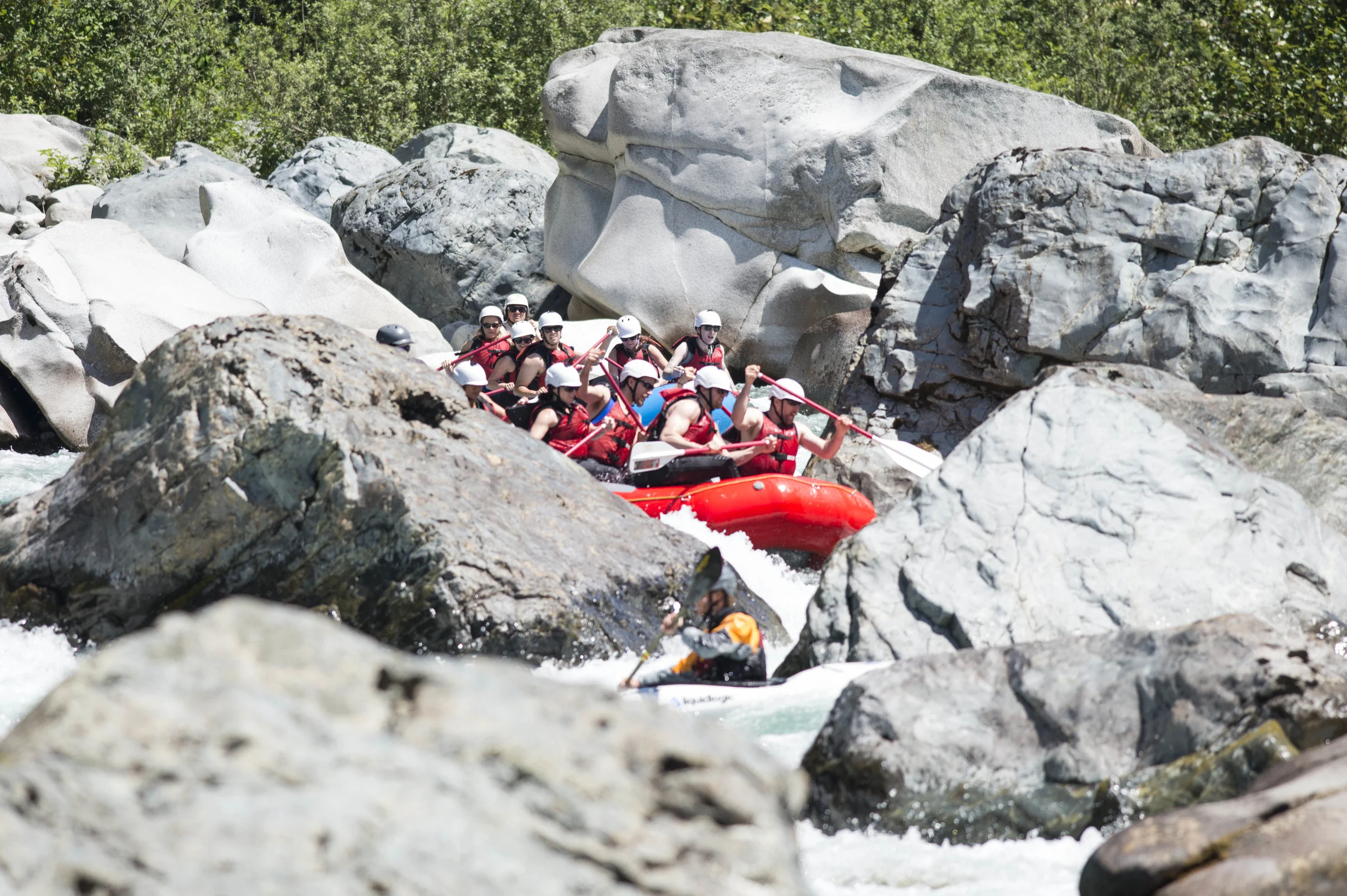
This SRT training course for the Seattle area teaches rescue techniques with limited resources in a remote setting. This three day 24-hr SRT course is for professional river guides as well as USFS and BLM employees.
River Rescue & Safety Training
River Rescue Essentials
(9 hour, one day intensive course)
Goals
Become clear, aware, confident, and safe while moving downriver.
Learn to be “receptive” to the river, its conditions, and those around you.
Develop decision making skills to avoid danger and mitigate risk.
Practice rescue plans in scenario based team oriented drills.
Practice individual tests to gain clarity on personal limitations.
Explore personal challenges in a group setting.
Learn to develop boundaries with team members and avoid drama.
Learn how to work and make decisions while cold, hurt, or exhausted.
Learn how to work and make decisions around others.
Become confident through experience developing hard skills.
Learn how to develop a personal training regimen to retain skills.
Learn how to be a supportive team member without stroking egos.
Examine how stereotypes and gender roles inhibit team performance.
Become aware of ego and hubris, and develop skills to avoid and work with them.
Become aware of dissociation and its typical role in incidents and rescues.
Develop systems of care for yourself and team members post rescue.
Remain focused and aware while outside of your comfort zone.
Allow yourself to fail in a safe environment, so you can succeed in an unsafe one.
Course Curriculum
Our Curriculum is focused on the skills most applicable to safety and prevention of injury, and follows this outline:
On Land
GAR
stamina, nutrition, hydration, fitness, team
Legal Liability
Communication
On River hand signals
Verbal communication (copy, roger, etc.)
PPE
Complex Risk Analysis
Risk Formula (x and y axis)
Danger Algebra (exponential risks with multiple risk factors)
The Human Factor
Note: Our method of risk analysis utilizes “root cause analysis” systems to identify subtle mistakes in the early planning stages that lead to harm (example; alcohol and drugs).
Hypoxic CPR
Throw bag toss
Knots
bowline
figure 8
prussic
water
double fisherman
Note: We do not teach knots in class; these are a part of the online training modules.
3-1, 5-1, 7-1 Z drags
anchors
basket
girth
On River
Whitewater swimming
swiftwater entry move defensive
aggressive
eddy twists
crossing rivers/currents
Throw bag rescue
static vs. dynamic belay
Tethered swimmer rescue awareness (optional)
Note: Not every person in a team needs to be a “strong swimmer” in order for this rescue to be effective.
Shallow water crossings
solo
A frame
pivot
foot entrapment prevention and rescue
Note: Foot entrapment extrication is almost always a body recovery, so we focus on prevention.
Raft flip recovery
single person flip recovery
tandem and team flip recovery
situational flips (shallow water vs. deep water)
flip recovery for normal people who can’t climb on top of a raft
Note: Raft flip recovery is the single most significant factor in raft fatality prevention.
Lines across the river (pick one)
tension D
hasty D
tethered craft
Course Cost: $250 per student, $1250 private course
*Online modules are 1-2 hours of additional time.
*One zoom meeting with instructor included.
Request More Information
Phone: 360-510-1243